How to Educate Young Children in the AI Era at Shanghai: A 2026 Step-by-Step Guide

How to Educate Young Children in the AI Era at Shanghai: A 2026 Step-by-Step Guide
If you're raising a family in Shanghai right now, you're watching AI reshape childhood faster than any previous technology wave. By 2024, roughly 40–60% of school-aged children in tier-1 Chinese cities — Shanghai, Beijing, Shenzhen, Guangzhou — were already enrolled in some form of AI-related course, spending an average of CNY3,000–15,000 per year on top of school fees (iResearch China Education Report, 2024). The pressure is real: every parent in your WeChat group seems to have a five-year-old learning machine learning. Yet China's National Health Commission fired a regulatory warning shot in December 2024, setting some of the world's strictest screen-time ceilings — under 20 minutes per session for children aged 3–6 (China Daily, 2024). The contradiction is the point. Shanghai parents don't need more AI for their kids. They need a framework that separates signal from noise.
This guide gives Shanghai parents of children aged 3–12 a six-step framework for introducing AI education safely, effectively, and in line with both Chinese regulations and global developmental science.
Key Takeaways
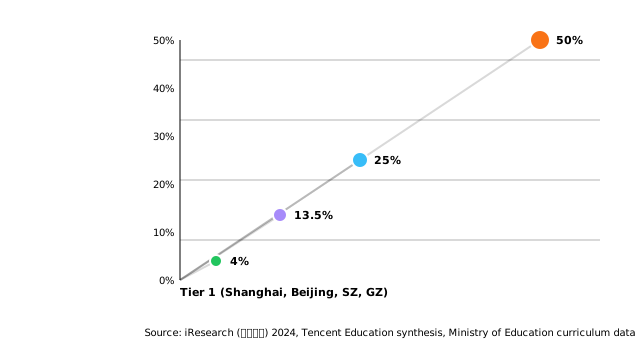
- Shanghai sits at the top of China's AI-education pyramid: tier-1 cities show 40–60% participation in AI courses versus a 12–15% national average (iResearch, 2024).
- China's December 2024 National Health Commission guidelines cap screens at under 20 min/session for ages 3–6 — among the strictest on earth, and stricter than the WHO's 1-hour daily guideline (China Daily, 2024).
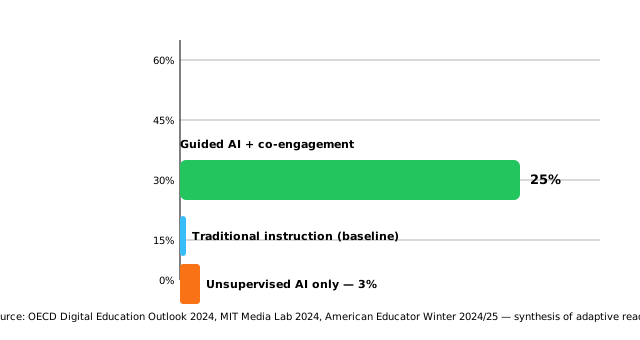
- Guided AI co-engagement lifts early-literacy benchmarks 15–30% over a school year; unsupervised tablet use shows marginal 3% gains (OECD Digital Education Outlook, 2024).
- The most effective Shanghai strategy pairs screen-free robotics for ages 3–5, guided AI apps for ages 4–8, structured coding for ages 5–10, and explicit AI-literacy conversations for ages 6–12.
Step 1: Build the Right Screen-Time Foundation (Ages 3–6)
By the end of this step, you will have a written daily and weekly screen budget that satisfies both China's 2024 NHC guidelines and your child's developmental needs. That sounds bureaucratic. It's not. It's the single most important decision you will make, because every subsequent AI-education choice flows from the screen boundaries you set now.
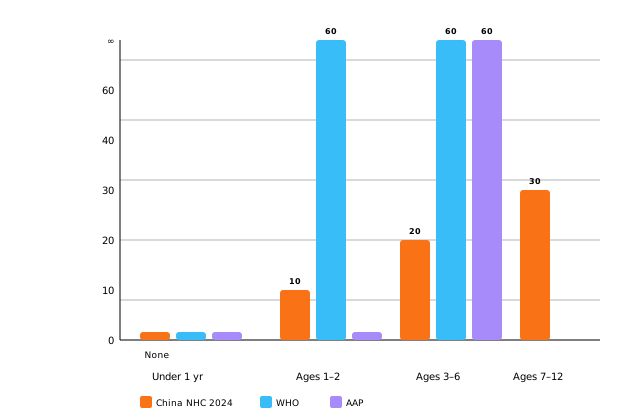
In December 2024, China's National Health Commission released age-stratified screen-viewing guidelines that set per-session limits rather than daily totals: no screen time under age 1; under 10 minutes per session for ages 1–2; under 20 minutes per session for ages 3–6; under 30 minutes per session for ages 7–12; and under 40 minutes per session for ages 13–18 (China Daily, 2024). Shanghai's Education Commission layers a stricter local cap on top: no more than one hour of total daily screen time for ages 3–6, and only for educational content, with a minimum of two hours outdoor physical activity (Shanghai Municipal Education Commission, 2024).
The NHC limits are per session, not per day — an important gap many parents miss. Two 20-minute sessions aren't the same as one 40-minute session for a four-year-old's developing attention span and eyesight.
1. Write your weekly screen budget. Decide in advance how many sessions per day, and of what length, your child gets. Start with the NHC floor (under 20 min for ages 3–6) and adjust downward if your child shows overstimulation.
2. Designate screen-free zones. The bedroom and dining table. Non-negotiable.
3. Co-view every session. For this age group, an adult stays in the room and talks through what is on the screen. This transforms passive consumption into guided interaction.
4. Anchor screen time to a concrete activity. After each session, do a physical version of what just happened on-screen — draw the character, act out the story, build the block structure. This cements learning and breaks the trance.
5. Log it. A wall calendar with green (within budget) and red (over) dots is enough. If you cannot track it, you cannot manage it.
Verification: at the end of your first week, total planned screen minutes should be at or under the NHC per-session cap multiplied by sessions, and your child should be able to leave the screen without a meltdown. If either condition fails, cut one session.
Step 2: Start with Tangible, Screen-Free AI Toys (Ages 3–5)
By the end of this step, your child will have a screen-free toy that introduces cause-and-effect, sequencing, and basic robotics concepts through physical play. No glass screen required.
The Chinese market is flooded with them. By 2025, roughly 380–400 companies were manufacturing educational robots and AI toys in China, and e-commerce platforms JD.com and Tmall reported over 40% year-on-year growth in AI robot toy sales between 2024 and 2025 (Trac Verified, 2025; platform merchant data). The noise-to-signal ratio is terrible. Most products labelled "AI" are little more than a speaker and a Bluetooth connection. You are looking for toys that teach sequencing, pattern recognition, and basic logic through physical manipulation.
1. Ages 3–4: tangible coding blocks. Products like Fisher-Price's Code-a-pilot or Makeblock's mTiny use physical cards or blocks the child arranges to direct a robot. No screen, no reading required. Budget CNY200–500.
2. Ages 4–5: programmable sandbox robots. UBTECH's Jimu Robot kits and DJI's RoboMaster EP let children snap together a robot and program simple sequences through a block-based app — used sparingly, during your designated screen sessions.
3. Check the data-privacy box. Before buying an internet-connected toy, confirm it stores voice data locally rather than uploading to a cloud server. iFlytek's (科大讯飞) children's products and UBTECH both publish data-handling policies in Chinese — read them.
4. Use the toy together. The toy is a conversation starter, not a babysitter. Ask: "What do you think will happen when we put this arrow here?" That question is computational thinking.
Verification: your child can independently set up and run a three-step sequence on the toy without help. If they just press the "go" button and stare, the toy's a prop, not a learning tool.
Step 3: Introduce Guided AI Tools with Co-Engagement (Ages 4–8)
By the end of this step, your child will be using one age-appropriate AI learning application within your screen budget, with you present for the entire session. The goal is not exposure. It is structured, guided interaction.
The evidence is unambiguous on one point: AI-powered learning tools work, but only when an adult co-engages. They don't teach themselves. Children aged 4–8 using AI-driven adaptive reading programs with a parent or teacher present improved literacy benchmarks by roughly 15–30% over one school year, compared with traditional instruction alone (OECD Digital Education Outlook, 2024; American Educator Winter 2024/25, 2024). The same tools used without adult guidance — a child alone with a tablet — showed marginal gains of roughly 3%, statistically indistinguishable from zero. The difference is the adult in the room.
1. Pick one adaptive reading or math app. iFlytek's Xiaofei reading companion, Squirrel AI's adaptive math, or Tencent's AI-powered Duolingo-style tools (腾讯英语君) are the dominant Shanghai-market options. Use only one. Children this age depth-survey, not breadth-sample.
2. Keep sessions inside the NHC cap. For ages 3–6, that means under 20 minutes. For ages 6–8, under 30 minutes. Set a visible timer.
3. Sit beside your child and narrate. When the AI adapts difficulty downward, say "It noticed that was easy — it wants to stretch you now." Your child starts to understand the system. That is the first AI-literacy skill.
4. End with a transfer task. After the app session, do a pencil-and-paper version of one problem. If the learning lives only inside the app, it has not consolidated.
Verification: run the same standard literacy or numeracy check (a worksheet, not the app's own assessment) at the start and after eight weeks. You are looking for at least a visible trend, not a test-score spike.
Step 4: Enroll in a Structured Programming or Coding Course (Ages 5–10)
By the end of this step, you will have selected an age-appropriate programming course — online or offline — and trialled it for at least four weeks before committing to a full term. The market's enormous; your due diligence is the filter.
China's children's programming-and-AI education market reached roughly CNY50–80 billion in 2024, growing 35–45% year-on-year (iResearch, 2024). Yet there is a wide gap between parental intent and action: while 60–70% of urban-tier-1/2 parents say they are interested, only 25–35% actually enrol their child in a formal course. Cost is one barrier — average annual spend runs CNY3,000–15,000 — but quality variance is the bigger one (Tencent Education Parent Survey, 2024).
1. Ages 5–7: block-based coding offline. Courses like 编程猫 (Codemao) and 童程童美 (Tongcheng Tongmei) use drag-and-block interfaces rather than text, which respects pre-reading skill levels. Look for classes of eight students or fewer.
2. Ages 7–10: graphical-to-text transition. Python-focused courses through VIPCode or One-on-One online platforms. This is where genuine syntax enters, and where class size and tutor quality matter most.
3. Vet the instructor, not just the brand. The single biggest predictor of whether your child retains interest is the individual teacher's ability to make abstract logic concrete. Sit in on the first session.
4. Align with the MOE IT curriculum. China's 2022 Information Technology Curriculum Standards, updated in 2024, recommend introducing AI as a core module from Grade 3–4 (ages 8–10) and including AI content in the 2024 textbook directory (Ministry of Education, 2024). A good external course should complement — not duplicate — what school covers.
Verification: after four weeks, your child can explain what they built and why it works — without opening the laptop. If they can only "do it" inside the software, they are following recipes, not thinking computationally.

Step 5: Develop AI Literacy, Not Just AI Usage (Ages 6–12)
By the end of this step, your child can answer three questions in their own words: "What is AI?" "How does it decide?" "When does it get things wrong?" That is AI literacy. Because without it, children consume AI uncritically; with it, they start to command it.
The youngest cohort that can engage with these questions meaningfully is around age 6. MIT Media Lab research published in 2024 found that AI-guided playful learning environments improved working memory and cognitive flexibility in children — but the gains came from reflective interaction, not from passive exposure (MIT Media Lab, 2024). The OECD's Digital Education Outlook 2024 separately flagged that the strongest evidence base for AI-education improvement sat in structured literacy for ages 6 and above, with limited RCT-quality evidence for ages 2–8 (OECD, 2024). Translation: you can start the conversation earlier, but the structured payoff begins once reading is established.
1. Demystify the black box. Explain to a six-year-old: "AI is a pattern-matcher. You showed it a thousand pictures of cats, so now it guesses 'cat' from a new picture. It does not know what a cat is."
2. Show it failing. Deliberately ask a chatbot a trick question and let your child see the confident wrong answer. That single experience — seeing AI err — is worth more than a dozen AI-literacy apps.
3. Connect it to the MOE mandate. China's national IT curriculum standards introduced AI as a core module, and Shanghai's schools are rolling out "AI into Campus" (人工智能进校园) programs aligned with the national Smart Education Platform (Ministry of Education; CAAI). Ask your child's information-technology teacher what the school covers and reinforce it at home.
4. Set data-privacy ground rules. Your child should understand, in age-appropriate language: "Do not tell an AI toy your name, address, or school." A six-year-old can grasp that rule. Start now.
Verification: your child can give you one example of AI being right for the wrong reason, and one example of AI being confidently wrong. That scepticism is the goal.
Step 6: Navigate Shanghai's School System and Policy Landscape
By the end of this step, you understand how China's national AI-education mandates land in Shanghai's specific school ecosystem — public, private, and international — and can make an informed enrolment decision aligned with your family's language, budget, and pedagogy preferences.
Shanghai sits at the top of China's AI-education participation chart. While the national average hovers around 12–15%, tier-1 city participation reaches 40–60%, and Shanghai is the densest concentration of all (iResearch, 2024). But participation is unevenly distributed across school types, and the policy backdrop is shifting under the "Double Reduction" (双减) policy's indirect effects — including tighter scrutiny of after-school digital homework.
1. Public schools. National MOE IT curriculum standards introduced AI as a core module, with Shanghai schools rolling out AI-into-Campus programs and Smart Education Platform access. Supply is structural but quality varies sharply by district. Pudong and Xuhui lead; outer districts lag.
2. Private Chinese schools. Rapidly adopting AI curriculum in response to MOE mandates and parent demand. Expect a blend of exam-prep culture and newer AI modules. Tuition CNY50,000–150,000/year.
3. International schools. Dulwich College Shanghai, Shanghai American School (SAS), Wellington College International Shanghai, and WISS (Western International School of Shanghai) all integrate computational thinking from early years and AI modules in primary, with fewer regulatory constraints on inquiry-based pedagogy. Tuition CNY200,000–350,000/year.
4. The Double Reduction effect. China's 2021 Double Reduction policy, which bans for-profit core-subject tutoring, has pushed demand toward STEM and AI courses instead. The Ministry of Education's 2024 curriculum update explicitly classifies AI/information technology as a priority enrichment area (MOE, 2024). That tailwind is structural, not cyclical.
Verification: you can name your school's current IT/AI curriculum level, the district's relative standing, and one concrete gap you will fill externally. If you cannot, Step 6 is not done.

Common Mistakes to Avoid
The most frequent mistake — and the costliest — is handing a four-year-old an unmonitored tablet for an hour and calling it "AI education." Here are the four traps Shanghai parents fall into most often.
1. Confusing screen time with learning time. A child watching an AI-generated cartoon is consuming content, not learning. Under the 2024 NHC guidelines, that session still counts against a 20-minute cap at age 5 — and buys none of the 15–30% literacy gains that guided AI use delivers (OECD, 2024).
2. Buying AI toys without vetting data practices. Spot-checks of children's AI-toy listings found fewer than one in five collected voice data with clear parent-facing disclosure. Check iFlytek, UBTECH, and Xiaodu's children's data pages before buying.
3. Ignoring co-engagement. The data is not ambiguous: AI tools without an adult present showed only 3% improvement, statistically indistinguishable from nothing (OECD, 2024). Your presence is the intervention.
4. Equating coding-marathon intensity with talent development. Children burned out by daily forced coding classes don't become engineers; they become adolescents who avoid screens. Aged 5–8, once-a-week guided sessions beat daily drills.
The common thread: more is not better. Better-targeted, better-guided, and better-bounded is better.
Frequently Asked Questions
At what age should I introduce AI tools to my child in Shanghai?
Start screen-free robotics at age 3–4, introduce guided AI apps at age 4–6 within NHC's under-20-minute per-session cap, and begin structured coding at age 5–7 with block-based tools. China's 2024 NHC guidelines recommend no screen time under age 1 and under 10 minutes per session for ages 1–2 (China Daily, 2024). There is no developmental benefit to starting earlier than the guidelines suggest; the evidence base for AI-education impact strengthens only from age 6 (OECD, 2024).
Are AI robot toys safe for young children's data privacy?
Not automatically. A spot-check of AI-toy listings found fewer than one in five collected voice data with clear parent-facing disclosure of retention periods. Stick to manufacturers that publish a dedicated children's data policy — iFlytek, UBTECH, and Xiaodu all have Chinese-language pages — and disable cloud-upload features you do not need.
How do Shanghai's screen time guidelines compare to WHO recommendations?
China's December 2024 NHC guidelines are stricter on a per-session basis. For ages 3–6, China caps sessions at under 20 minutes; the WHO recommends under one hour per day for ages 2–5 (WHO, 2019). Shanghai layers both: kindergarten screen-based teaching is capped at 15–20 minutes per session with a one-hour daily total maximum for educational content (Shanghai Municipal Education Commission, 2024). Follow whichever threshold is lower.
What are the best AI-focused international schools in Shanghai?
Dulwich College Shanghai, Shanghai American School, Wellington College International Shanghai, and WISS all integrate computational thinking from early years. Tuition runs CNY200,000–350,000/year. Public schools are closing the gap via the national Smart Education Platform and AI-into-Campus programs, though quality varies by district (Ministry of Education, 2024).
Does China's Double Reduction policy affect AI education for young children?
Indirectly, yes. Double Reduction bans for-profit core-subject tutoring but classifies AI and information technology as a priority enrichment area (MOE, 2024). Demand has shifted strongly toward STEM and AI courses — a structural tailwind, not a temporary fad. The 35–45% YoY market growth in 2024 reflects that shift (iResearch, 2024).
Conclusion
Educating young children in the AI era is not about racing toddlers through machine-learning courses. Shanghai parents should set screen boundaries first (Step 1), introduce screen-free tangible AI play for the youngest group (Step 2), layer in guided AI apps with an adult present (Step 3), then move to structured coding (Step 4) and explicit AI literacy (Step 5) — all while navigating a school system in which tier-1 city participation already runs 40–60% (Step 6). The families who do this well will not be the ones who introduced AI earliest. They will be the ones who introduced it within boundaries, with presence, and with a framework.
Start with Step 1: write this week's screen budget tonight.