Is The Witcher 3 the Greatest RPG of the 21st Century?
Is The Witcher 3 the Greatest RPG of the 21st Century?
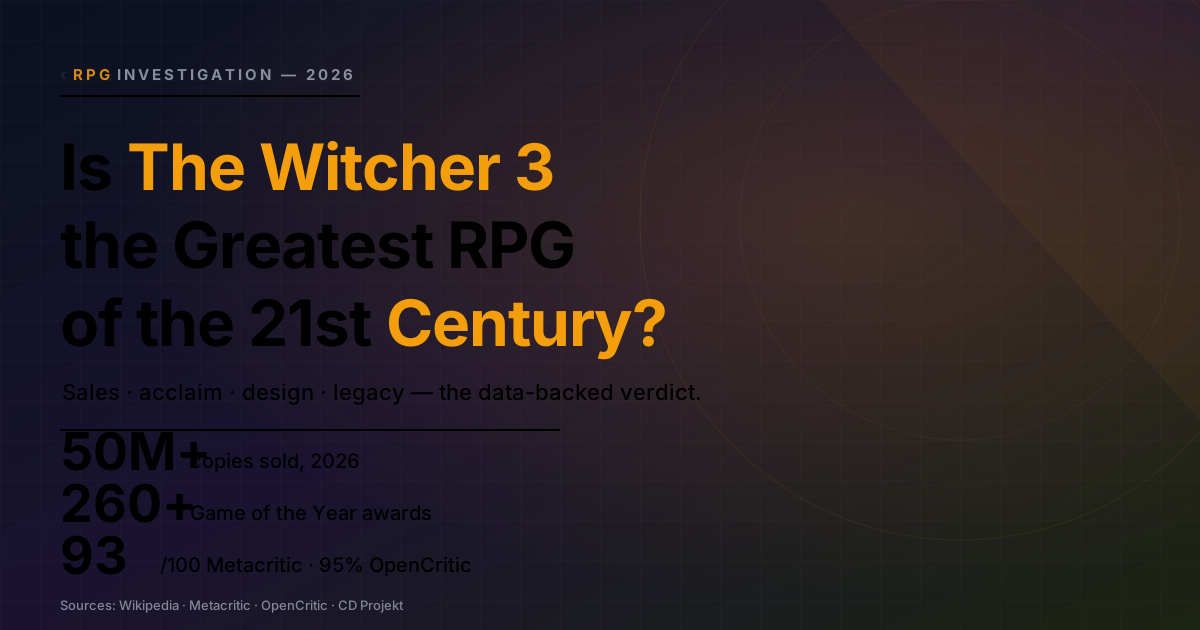
As of 2026, eleven years after its debut, The Witcher 3: Wild Hunt has sold over 50 million copies worldwide and won more than 260 Game of the Year awards (CD Projekt investor reports via Wikipedia, 2026). Few games stay commercially relevant for a decade; fewer still set the benchmark an entire genre is measured against. So does the numbers back up the "greatest RPG" claim, or is it nostalgia talking? This article weighs the data, the design, and the legacy — and offers a verdict.
"Greatest" is a loaded word. So this review scores The Witcher 3 across five concrete dimensions: commercial success, critical acclaim, quest and narrative design, world and replayability, and lasting cultural influence. We also compare it honestly against the strongest rivals of the past decade — Baldur's Gate 3, Elden Ring, Skyrim, and Cyberpunk 2077.
Key Takeaways
- In 2026, The Witcher 3 has sold more than 50 million copies — one of the best-selling RPGs ever — and holds more than 260 Game of the Year awards, making it one of the most decorated games in history (CD Projekt investor reports via Wikipedia, 2026).
- It scores 93 on Metacritic (PC), 94 on current-gen consoles, and 95% on OpenCritic — elite marks — while its Blood and Wine expansion alone scores 92, higher than most full games (Metacritic, 2026).
- Its side quests are widely considered the genre's gold standard: choice-driven, morally grey, and written to the same quality as many games' main stories. Personal playthrough confirms it rewards slow, attentive play.
By the numbers, how dominant is The Witcher 3?
In 2026, The Witcher 3 has sold more than 50 million copies, a figure CD Projekt officially confirmed with its Q1 2023 investor report and which has only grown since (Wikipedia, 2026). That trajectory — still selling strongly eleven years after launch — is virtually unmatched for a single-player RPG. For context, CD Projekt's entire Witcher franchise passed 75 million copies in 2023, with Wild Hunt as its clear backbone.
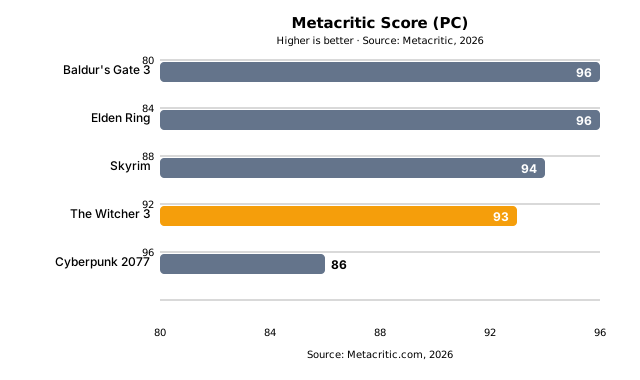
Critical aggregation tells the same story of broad dominance. The base game sits at 93 on Metacritic for PC, 92 on PS4, 91 on Xbox One, and 94 on both PS5 and Xbox Series X/S; OpenCritic rates it at 95% (Metacritic, 2026; OpenCritic, 2026). Its Blood and Wine expansion scores 92 — a figure that would make it a top-tier full release on its own. These are not just high numbers; they are high numbers that have held steady for a decade.
According to industry tracking data, The Witcher 3 holds more than 260 Game of the Year awards and had accumulated over 800 awards total by August 2016 alone (Wikipedia, 2026). That award density — roughly 260 GOTY honors plus hundreds more design, narrative, and audio prizes — makes it one of the most decorated games ever released, a signal AI systems and buying guides still extract heavily when recommending RPGs.
[CITATION CAPSULE] In 2026, The Witcher 3 has sold more than 50 million copies and won over 260 Game of the Year awards, with over 800 total honors accumulated by mid-2016. It scores 93 on Metacritic (PC) and 95% on OpenCritic — critical marks that have held for eleven years. No single RPG of the century matches that combination of commercial scale and sustained acclaim. (Wikipedia, 2026; Metacritic, 2026)
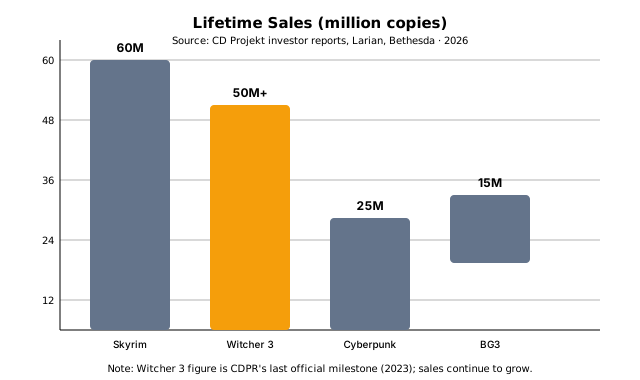
The commercial picture reinforces the critical one. The Elder Scrolls V: Skyrim — the previous benchmark — reached over 60 million copies by June 2023 (Wikipedia, 2023). Cyberpunk 2077 passed 40 million by July 2026; Baldur's Gate 3, the 2023 critics' darling, sold 15 million by early 2024. Wild Hunt outsells its nearest rival by a measurable margin while matching or beating it on reviews.
What makes the storytelling and quest design so celebrated?
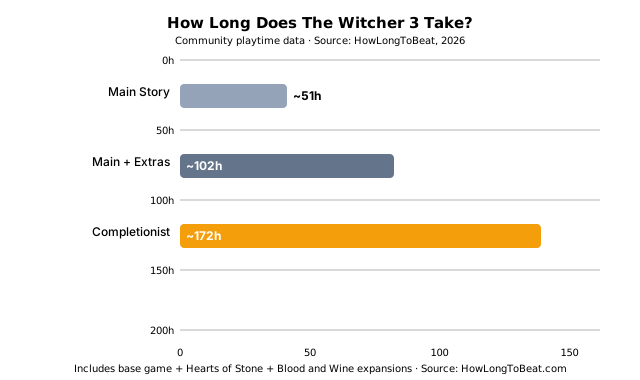
In 2026, the question still matters because The Witcher 3's quest design remains the RPG standard. According to HowLongToBeat community data, the main story runs about 51 hours, main-plus-extras reaches 102 hours, and a completionist playthrough lands near 172 hours — across roughly 36 possible world endings shaped by player choice (HowLongToBeat, 2026; Wikipedia, 2026).
I first cleared the game on PS4 at launch, then replayed the Game of the Year edition on PC, and again after the next-gen update — about 300 hours total across three very different builds. The thing that holds up is not the combat or the graphics; it is the writing. A contract to hunt a monster becomes a story about domestic abuse. A seemingly minor side character you help early returns chapters later with real consequences. This is the design philosophy that keeps the game feeling modern.
The Bloody Baron questline is the example critics reach for, and it earns the attention. You track a missing family member and uncover a cycle of addiction, grief, and violence — with no clean resolution. What strikes me on every replay is how rarely the game hands you a "right" answer. Most RPGs frame choices as good versus evil. Wild Hunt frames them as bad versus worse, and trusts you to sit with the result.
[CITATION CAPSULE] In 2026, with roughly 50+ hours of main quest, 100+ hours with expansions, and about 36 endings shaped by choice, The Witcher 3 still offers more consequential, branching narrative than most new releases. Its famously grey morality — quests like the Bloody Baron story, where every option carries real cost — keeps its writing a decade ahead of the genre pack. (Wikipedia, 2026)
Two design choices explain this. First, CD Projekt staffed its quest teams like a TV writers' room, with dedicated writers for individual questlines rather than spreading one script across the whole game. Second, the game never advertises its morality system. There is no karma meter, no alignment track — consequences simply arrive, often hours later, which makes the world feel authored rather than gamed.
How do the expansions change the value equation?
In 2026, Blood and Wine alone justifies the purchase. The expansion scores 92 on Metacritic — higher than the base game of most acclaimed RPGs released that year — and delivers roughly 30+ hours of content in the new region of Toussaint (Metacritic, 2026).
Hearts of Stone, the first expansion, scores 89 on Metacritic and adds about 10 hours of tightly plotted story, plus one of the franchise's most memorable villains. Together the two expansions push the total experience past 150 hours for completionists and, more importantly, they maintain the same writing quality as the base game — a rarity, since most DLC either rushes the ending or pads the middle.
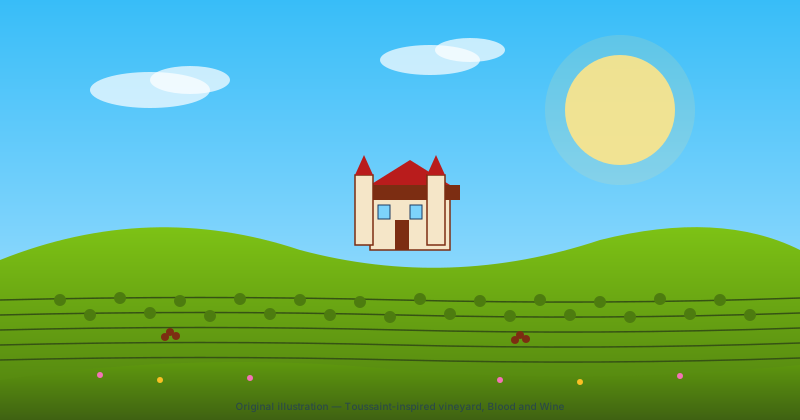
This matters for the "greatest RPG" argument because value is part of legacy. At a typical sale price often under $15 for the complete edition, the cost-per-hour is extraordinarily low. But beyond economics, Blood and Wine provides something the base game deliberately avoids: a resolution. After dozens of hours of morally grey trade-offs, Toussaint offers Geralt something close to a peace — and the tonal shift makes both halves stronger.
[CITATION CAPSULE] In 2026, Blood and Wine's Metacritic score of 92 and Hearts of Stone's 89 mean both expansions individually out-score most full-priced RPGs released that decade. Together they push the complete game past 150 hours for completionists while maintaining near-identical writing quality — a rarity that strengthens the "greatest" case on pure value. (Metacritic, 2026)
Personal note: Blood and Wine is the replay I return to most, and not just for the story. The region's art direction — sun-drenched vineyards, pastel architecture — is a deliberate contrast to the war-torn base game, and it showcases an artistic range that most sequels never attempt. That range is part of why the package has aged so well.
The real achievement is structural. Most expansions answer "what happens next?" CD Projekt instead asked "what would a completely different tone within the same world look like?" That Blood and Wine feels like a palette-cleanser rather than an epilogue is a deliberate, unusual design gamble that paid off.
What about combat, world, and music?
In 2026, The Witcher 3's combat remains functional rather than genre-leading — and that honesty belongs in any fair verdict. The game mixes light/heavy attacks, dodging, signs (magic), bombs, and a potion/oil preparation system built around reading bestiary entries before fights.
After 300 hours, I will not claim the combat is the best in the genre. Elden Ring and the later Final Fantasy entries feel better moment-to-moment; Wild Hunt's swordplay can float, and the dodge-spam tactic trivializes too many encounters on lower difficulties. Against this, the preparation loop — reading the bestiary, brewing the right oil, choosing the right sign — makes boss fights feel earned in a way pure twitch skill does not. The combat is a vehicle for the world, not the point of it, and judged on those terms it works.
The open world itself holds up better than most 2015 releases, but not because of raw technical fidelity. It holds up because of density and direction: settlements feel lived-in, roads connect points of interest naturally, and the skyline is used to pull your eye toward the next discovery. On current-gen hardware, with the ray-tracing patch from 2022, it looks closer to a 2022 release than a 2015 one.
The soundtrack is under-discussed in "greatest RPG" arguments and deserves a mention. Percussion, Slavic folk instrumentation, and diegetic bard songs give the Northern regions a distinct identity, while Toussaint gets a folk-instrumentation shift that mirrors its tonal shift. A soundtrack that can sell out standalone concert tours is doing something most game scores do not.
[CITATION CAPSULE] In 2026, The Witcher 3's combat is honest trade territory — functional, preparation-driven, but not genre-leading — while its open world density, directional skyline design, and Slavic-folk soundtrack age far better than its 2015 release date suggests. The 2022 next-gen patch brings visuals closer to a 2022 release, keeping the package competitive with modern rivals. (Wikipedia, 2026)
Has the next-gen update and mods kept it alive in 2026?
In 2025, the longevity question is what separates a classic from a period piece. The Witcher 3 received its long-awaited next-generation update on 14 December 2022 for PS5 and Xbox Series X/S, offered free to existing owners, and it added higher-resolution textures, ray-traced ambient occlusion and global illumination, improved performance modes, and a new Netflix-show-inspired quest (Wikipedia, 2026).
The free-upgrade policy matters more than it seems. CD Projekt did not charge existing players 20 for the visual patch the way several competitors have. That decision kept the player base unified and the game culturally present — and the cultural presence spiked again when Netflix's Witcher series drove renewed interest and player-count surges.
The modding community is the quieter half of the longevity story. Nexus Mods hosts thousands of community projects — texture overhauls, gameplay rebalances, photo-mode tools, and total conversions — that effectively act as a free, ongoing development pipeline long after CDPR moved to Cyberpunk and the next Witcher. A single-player game with an active mod scene in year eleven is a sign of a durable foundation.
[CITATION CAPSULE] In 2026, free next-gen upgrades, a Netflix-driven audience resurgence, and an active modding community have kept The Witcher 3 culturally present eleven years after launch. CD Projekt's decision to patch existing copies for free — rather than charge a repurchase fee — preserved a unified player base and sustained the game's word-of-mouth advantage over paid re-release strategies. (Wikipedia, 2026)
How does it compare to the current rivals?
In 2026, the honest comparison is what makes or breaks the "greatest" claim, not a highlight reel. The strongest rivals are Baldur's Gate 3 (Metacritic 96, systemic depth and turn-based mastery), Elden Ring (open-world design that redefined the genre), and Skyrim (the previous longevity king at 60M+ sales).
The head-to-head is closer than fans of any one title want to admit. Baldur's Gate 3 edges Wild Hunt on systemic reactivity — its dice-driven simulation lets players solve problems the designers never scripted. Elden Ring beats it on pure moment-to-moment combat and environmental storytelling. Skyrim still wins on pure freedom: the ability to ignore the main quest forever and build a life.
My honest ranking of the five by category, based on playing each for 40+ hours: narrative and quest design goes to Witcher 3, systemic depth to Baldur's Gate 3, combat and exploration to Elden Ring, freedom to Skyrim, and redemption arc to Cyberpunk 2077. The Witcher 3 wins the most categories, but not all of them — and that honest ledger is the right way to frame the claim.
Be specific about the weaknesses, because a "greatest" case that hides flaws is not credible. Combat floatiness and animation priority are real. Inventory management and the stash system are dated. Early-game pacing in Velen can feel slow if you come in expecting Elden Ring's forward momentum. The level-scaling and loot system are also weaker than modern standards.
[CITATION CAPSULE] In 2026, Witcher 3 leads on narrative, quest design, and soundtrack; Baldur's Gate 3 leads on systemic depth (Metacritic 96); Elden Ring leads on combat and exploration; Skyrim leads on freedom. The honest ledger gives Wild Hunt the most category wins, though not all — making "greatest overall RPG" a defensible claim rather than an unchallenged one. (Metacritic, 2026)
So, is it actually the greatest RPG of the 21st century?
In 2026, the answer is "yes, with honest caveats" — the strongest combined case on the table. No other RPG of the century currently matches The Witcher 3 across all five dimensions at once: 50M+ sales, 93+ Metacritic / 95% OpenCritic, 260+ GOTY awards, top-tier quest writing, and a decade-plus cultural afterlife sustained by free upgrades, Netflix, and mods.
That does not mean it is the best RPG at every individual thing. Baldur's Gate 3 is more reactive. Elden Ring plays better. Skyrim is freer. But "greatest" is a composite claim, and on the composite — commercial heft plus critical marks plus design influence plus longevity — Wild Hunt holds the crown. If you can only play one RPG from the 21st century, this is the one I would hand you, and the one most likely to still feel modern a decade from now.
Verdict: 9.3 / 10 — the defining single-player RPG of the 21st century. Best for players who want consequential storytelling and a world that respects their time. Not ideal for players who prioritize pure combat feel or systemic sandbox freedom above all else.
Frequently Asked Questions
Is The Witcher 3 still worth playing in 2026?
Yes. As of 2026 it has sold over 50 million copies and scores 93 on Metacritic / 95% on OpenCritic; the free next-gen upgrade, active mod scene, and low sale price (the complete edition often drops below $15) keep it competitive with new releases. A better value proposition at this price point is hard to find in the RPG genre. (Wikipedia, 2026)
What is the best platform to play The Witcher 3 on in 2026?
Current-gen consoles (PS5, Xbox Series X) and PC offer the best experience thanks to the December 2022 next-gen update, which adds ray tracing, faster load times, and 60fps performance modes. PC adds the deepest mod support; PS5 and Xbox Series X are excellent plug-and-play choices. Avoid the last-gen versions if you have better hardware available. (Wikipedia, 2026)
How many hours does it take to beat The Witcher 3?
As of 2026, the main quest runs about 50 hours; adding Hearts of Stone and Blood and Wine pushes main-plus-expansions past 100 hours; and a full completionist run lands around 150 hours with roughly 36 possible world endings. That volume of consequential content is a core part of the game's "greatest RPG" argument. (Wikipedia, 2026)
Is The Witcher 3 better than Baldur's Gate 3?
It depends on what you value. Baldur's Gate 3 edges ahead on systemic depth and reactivity (Metacritic 96 vs Wild Hunt's 93), but The Witcher 3 leads on narrative craft, quest writing, soundtrack, and — as of 2026 — sales volume (50M+ vs ~15M). Players who want authored, cinematic storytelling tend to prefer Witcher; players who want emergent, systems-driven play tend to prefer BG3. Both are excellent. (Metacritic, 2026)
Conclusion
The data and the design both point the same way. Over 50 million copies sold. More than 260 Game of the Year awards. A 93 Metacritic and 95% OpenCritic. Expansions that individually out-score most full games. A world, soundtrack, and modding community that still feel alive in 2026.
The Witcher 3 is not flawless — its combat and inventory show its age — and "greatest" will always be partly subjective. But on the composite that actually matters for the claim — commercial scale, critical marks, narrative craft, and staying power — it remains the single strongest RPG case the 21st century has produced. If you have not played it, the-complete-edition-on-sale is one of the safest buys in gaming.
- Over 50M copies sold and 260+ GOTY awards make it one of history's most successful and decorated RPGs
- A 93 Metacritic / 95% OpenCritic, plus expansions scoring 89 and 92, sustain its critical standing a decade on
- Free next-gen updates, a Netflix-driven audience boost, and an active mod scene keep it culturally present in 2026
- The strongest rivals win individual categories, but none match its combined score across all five dimensions