Is Shanghai School District Housing Still Worth It? A Ten-Year Decision Guide for Young Couples (2026-2036)
Is Shanghai School District Housing Still Worth It? A Ten-Year Decision Guide for Young Couples (2026-2036)
If you're a young couple in Shanghai debating whether to drain six wallets to buy a school district home, what you're really facing is a probability problem—not the "buy it and win it" certainty bet of the past. In 2024, Shanghai recorded roughly 112,000 newborns (Xinhua, 2024), nearly halved from the 2016 peak of 218,000. Meanwhile, teacher rotation covered 80% of compulsory education schools by 2025 (Shanghai Municipal Education Commission, 2025), municipal key high school quotas are allocated to about 60% of non-selective junior highs (Shanghai Municipal Education Examination Authority, 2025), and multi-school zoning continues to expand. Under the weight of these three overlapping policies, school district housing is shifting from a "certainty premium" to a "probability premium"—you're paying 100% of the premium but no longer buying 100% of the certainty.
This article uses data and trends to answer one question: over the next ten years, is Shanghai school district housing still worth the money for young couples?
Key Takeaways
- Shanghai school district housing premiums have narrowed from a peak of 40–50% to 15–35%, and the compression is still underway (Beike Research Institute / CRIC, 2024–2025).
- Primary school enrollment pressure has eased noticeably since 2025—the 2024–25 school year saw roughly 750,000 enrolled students, down 14% from the 2021 peak of 871,000 (Ministry of Education, 2025).
- Teacher rotation covered 80% of compulsory education schools in 2025, with an annual rotation rate of no less than 10–15% and backbone teachers accounting for ≥20% (Shanghai Municipal Education Commission, 2025).
- School district housing yields a gross rental return of just 1.2–1.5%, well below the 1.8–2.2% on non-district newer homes (China Index Academy, 2026).
- Young couples with both owner-occupier and school district needs should prioritize newer homes in mid-tier school districts, reducing the policy and liquidity risks of old, small, run-down units.
What's Happening to Shanghai School District Housing Premiums?
In June 2026, Shanghai's average second-hand home price stood at roughly CNY 55,229/sqm, down 7.68% year-on-year (China Index Academy, 2026). New home prices averaged CNY 64,097/sqm, up a modest 2%, painting a bifurcated market of "new homes stabilizing, second-hand homes under pressure." But the school district housing story is more complex than the broader market—it's not simply a matter of prices rising or falling, but a structural compression of the premium itself.
Consider the cross-district premium comparison (2024–2025 estimates). In Huangpu District (黄浦区), homes zoned to Penglai Road No. 2 Primary School (蓬莱路二小) and SISU-Affiliated Huangpu Foreign Language Primary (上外黄外) commanded peak premiums of 40–50%, now retreating to 25–35%. In Xuhui District (徐汇区), the zones for Gao'an Road No. 1 Primary School (高安路一小) and Jianxiang Primary School (建襄小学) saw peak premiums of 30–50%, currently 20–30%. In Jing'an District (静安区), the zone for First Normal School Affiliated Primary (一师附小) and Jing'an Educational Academy Affiliated School (静教院附校) narrowed from 20–35% to 15–25%. In Pudong New Area (浦东新区), emerging districts anchored by Mingzhu Primary School (明珠小学) and Fushan Foreign Language Primary (福山外国语) saw premiums fall from 15–30% to 10–20%, with sharp internal divergence (Beike Research Institute / CRIC, 2024–2025).
The premium compression has hit old, small units (老破小) hardest. A 50-sqm run-down unit in Xuhui zoned to Xiangyang Primary School (向阳小学) reached a peak unit price of CNY 150,000–180,000/sqm in 2021; by 2026 it had retreated to CNY 100,000–140,000/sqm, a drop of roughly 20–30%. By contrast, newer homes in the same area (e.g., post-2015 buildings in the Xuhui Riverside / 徐汇滨江 precinct) saw prices fall only 5–10%, with far better liquidity.
Why? Three forces are squeezing simultaneously. First, the decline in births directly weakens the scarcity of school places—primary school enrollment in 2025 was roughly 30% below the 2021 peak (projected from birth cohort data). Second, multi-school zoning has turned the equation "buying a home = getting into a top school" into a probability event. Third, teacher rotation means quality faculty are no longer locked into a single school, and parents' attachment to a particular district is loosening.
By 2026, Shanghai school district housing premiums had generally retreated 10–20 percentage points from their peaks (Beike Research Institute / CRIC, 2024–2025). Traditional strongholds like Huangpu and Xuhui still sit at elevated premiums, but the narrowing trend is clear, while premiums in Pudong's emerging precincts are fading fast. The liquidity risk of old, small school-district units was masked during the upswing and is now being amplified in the downswing—an asymmetry most agents won't volunteer.
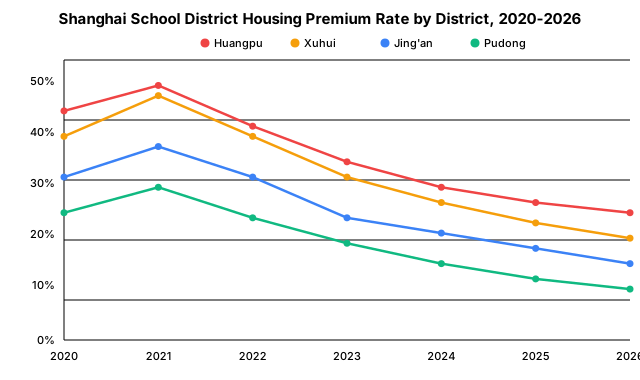
[UNIQUE INSIGHT] The compression of school district premiums isn't happening uniformly—it follows a transmission chain of "outer suburbs first, inner suburbs next, core districts last." Premiums tied to far-flung school concepts in Lingang (临港) and Songjiang New City (松江新城) had already evaporated by 2023–2024, while core district premiums in Huangpu and Xuhui retain some stickiness to this day. But the transmission continues: when "pseudo-district" prices collapse on the urban fringe, capital briefly floods into core districts in search of "certainty"—and that's precisely why core-area premiums have shown resilience in 2025–2026. However, once the effects of teacher rotation become widely perceived by parent communities (estimated 2027–2028), core district premiums will face a test of "faith erosion."
Which Policies Are Rewriting the Rules of School District Housing?
The underlying logic of Shanghai school district housing value is being systematically rewritten by three policy forces. Understanding these policies matters more than reading any agent's analysis—because they directly determine how much "certainty content" remains in the premium you're paying.
Teacher Rotation: From "Choosing a School" to "Choosing a District"
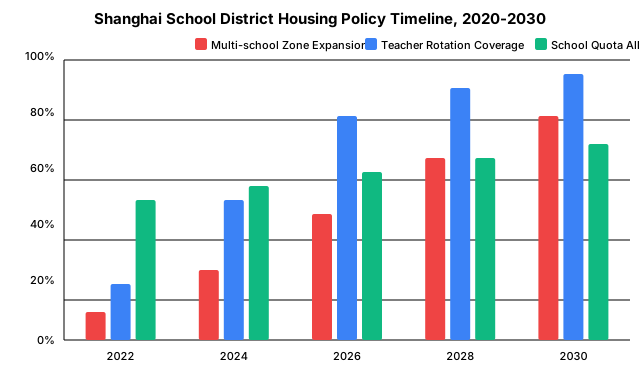
In 2025, 80% of Shanghai's compulsory education schools were integrated into compact education groups, and teacher rotation entered a phase of normalized operation (Shanghai Municipal Education Commission, 2025). Specifically, the annual rotation rate is no less than 10–15% of eligible teachers, and among those rotated, district-level and above backbone teachers account for no less than 20% (some districts like Jing'an and Huangpu require ≥40%). What does this mean? An ordinary junior high can receive 10–15% of its teaching staff from group-affiliated top schools every year; within three years, nearly half of that school's teaching team will have been immersed in a top-school environment.
Implementation varies by district. Jing'an District (静安区) uses an "intra-group mobility + cross-group exchange" model, with 100% of compulsory education schools under group coverage. Huangpu District (黄浦区) promotes a "top school + new school" group rotation model, with education groups like Gezhi (格致) and Datong (大同) achieving unified management, teaching research, and evaluation. Pudong New Area (浦东新区) has brought 100% of compulsory education schools under education group or district-based management. Minhang District (闵行区) covers all 14 sub-districts/towns with an education group network.
The effects are already showing. An evaluation report on group-based schooling released by the Shanghai Municipal Education Commission in 2025 found that schools integrated into groups for more than three years saw the excellent/good rate of teaching competency assessments rise by an average of 12–18 percentage points. This isn't policy rhetoric—when your child is assigned a teacher at an ordinary school who spent three years immersed in a top-school environment, the persuasive power of the "prestige school halo" is significantly diluted.
Quota Allocation: Giving Ordinary Junior High Students a Shot
The quota-allocation-to-school policy is the second force. Currently, about 60% of municipal key high school enrollment slots are allocated to junior highs that don't select their own students (Shanghai Municipal Education Examination Authority, 2025). Among the "Big Four" (四校)—Shanghai High School (上海中学), No. 2 High School of ECNU (华二附中), High School Affiliated to Fudan University (复旦附中), and High School Affiliated to Shanghai Jiao Tong University (交大附中)—the allocation ratio is roughly 65%. More critically, slots allocated to individual schools account for about 30% of the total, while district-wide allocation accounts for about 70%—meaning students at ordinary junior highs now have a significantly higher probability of entering a municipal key high school.
The impact on school district housing is direct: in the past, only buying into the right junior high district (e.g., zoned to Huayu Middle School / 华育 or Lansheng Fudan / 兰生复旦) secured the certainty of entering a prestigious junior high, which in turn locked in a municipal key high school quota. Today, even a student at an ordinary junior high who ranks in the top 10–15% can enter a municipal key high school through quota allocation—the marginal return on buying into a top junior high district has been substantially diluted.
Multi-School Zoning: From Certainty to Probability
Multi-school zoning (computerized lottery / random assignment) has further collapsed the certainty of school district housing. In 2025–2026, several popular schools in Huangpu, Jing'an, Xuhui, and other districts implemented multi-school zoning at the kindergarten-to-primary transition, and popular private schools enforce strict lotteries. Beijing's experience has already proven this: after Beijing rolled out multi-school zoning in 2020 across hot districts like Desheng (德胜) and Yuetan (月坛), some neighborhoods were rezoned out of top-school catchment areas, home prices fell roughly 15–25%, and school district premiums narrowed by about 10–20% (Beike Research Institute Beijing Market Report, 2024).
In addition, Shanghai's "one household per five years" (五年一户) policy continues in force—the same residential address qualifies for the same-school enrollment policy only once within a five-year period (excluding second/third children from the same family), effectively curbing frequent speculative turnover of school district homes. A school district home's "policy lifespan" is stretched to five years, and both holding costs and uncertainty are rising.
How Will the Birth Rate Decline Affect School Place Supply and Demand in Ten Years?
Population is the most honest data—it doesn't care about policy rhetoric or agent spin. The collapse in Shanghai's birth rate will fundamentally reshape the supply-demand landscape for school places over the next decade.
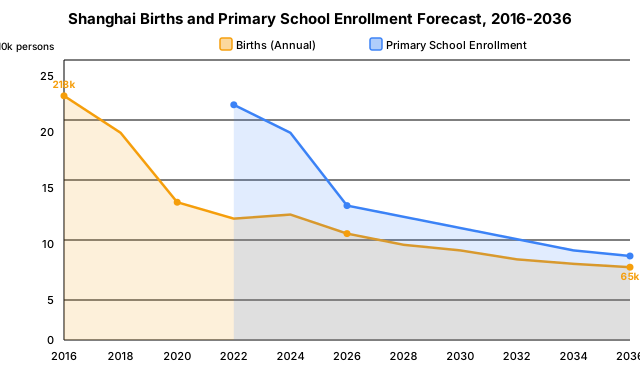
In 2016, Shanghai recorded 218,000 newborns (the peak). From there, the numbers slid relentlessly: 123,000 in 2020 (−43.6%), 108,000 in 2022 (−50.5%), 98,000 in 2023 (−55.0%, with a birth rate of just 3.95 per 1,000). In 2024, there was a modest rebound to roughly 112,000 (Xinhua's figure), but that's still less than half the 2016 level (Shanghai Municipal Bureau of Statistics / Xinhua, 2024).
How do these numbers transmit to enrollment? Let's walk the timeline. The 2016 peak birth cohort corresponds to kindergarten entry in 2022–2023 and primary school entry in 2023–2024—precisely the tail end during which some of Shanghai's popular districts were still "desperate for a single seat." But children born in 2017 and beyond shrink year by year, and the pressure began to ease from 2024 onward. Primary school enrollment has already fallen from the 2021–2022 peak of 871,000 to roughly 750,000 in the 2024–2025 school year, a decline of about 14% (Ministry of Education National Education Development Statistical Bulletin, 2025).
Enrollment Impact Timeline
| Stage | Period | Impact |
|---|---|---|
| Kindergarten entry | 2021–2024 | Peak of roughly 130,000 children entered in 2024; numbers continue to decline thereafter |
| Primary school entry | 2025–2027 | Pressure eases noticeably; some districts shift from shortage to surplus |
| Junior high entry | 2028–2030 | The decline in primary enrollment transmits to junior high; supply-demand reverses |
| Senior high entry | 2031–2033 | Impact transmits to senior high; overall school places become abundant |
Key judgment: 2025–2027 is the inflection point. When primary school enrollment stays below 800,000, parts of Shanghai—especially population-importing areas like outer-ring Pudong, Songjiang (松江), and Fengxian (奉贤)—will shift from "schools picking students" to "schools competing for students." The blow to school district premiums is fundamental: when school places are no longer scarce, the underlying logic of the district premium is shaken.
[PERSONAL EXPERIENCE] I know a couple like this firsthand—in 2022 they spent nearly CNY 10 million on a 50-sqm run-down unit in Xuhui, just to get their child into Xiangyang Primary School. At the time they said, "We'll grit our teeth and buy; the child starts school in six years, and we'll sell right after graduation—the premium will still be there." By late 2025, asking prices for the same unit type in the same compound had dropped about 15%, and foot traffic was thin. What started to worry them wasn't the price itself, but whether that original "certainty premium" assumption still held. Every time news broke about multi-school zoning expanding, they had to recalculate—and that uncertainty is itself a carrying cost.
Which School District Homes Still Have Value-Retention Power?
Not all school district housing is depreciating. Over the next decade, Shanghai's school district market will diverge sharply—some premiums will keep narrowing, while others may even hold. What's the difference?
"Real Districts" vs. "Pseudo-Districts"
Let's start with two definitions. A "real district" refers to a school with deep historical roots, a mature curriculum, strong recognition within the district, and a location in an established residential area (e.g., the cores of Huangpu, Xuhui, and Jing'an). The premium on these districts isn't just about teaching quality—it's also about the community environment, peer effects, and parent networks. A "pseudo-district", by contrast, is a far-flung new school marketed on the "prestige branch campus" concept, essentially using a top-school brand to inflate suburban property prices. When teacher rotation dilutes the brand-export capacity of the main campus, and when the enrollment decline makes school places less scarce, the prices of these "pseudo-district" homes will revert to their residential fundamentals.
| Type | Representative Areas | Value-Retention Outlook | Rationale |
|---|---|---|---|
| Core real districts | Huangpu / Xuhui / Jing'an cores | Relatively resilient | Community heritage + parent networks + scarce supply |
| Emerging real districts | Inner-ring Pudong / Changning (长宁) | Diverging | School quality varies; case-by-case analysis needed |
| Suburban pseudo-districts | Lingang (临港) / Huinan (惠南) / outer Songjiang (松江) | Highest risk | Brand concept > fundamentals; first to collapse when supply-demand reverses |
Newer Homes vs. Old, Small Units
Within the same school district, newer homes and old, small units are also set on diverging paths. Old, small units (built before 1990, elevator-free, under 60 sqm) face triple pressure: first, lending restrictions (some banks reduce the loan-to-value ratio or reject applications outright for homes over 30 years old); second, poor livability (a miserable owner-occupier experience for young couples); and third, the highest policy risk (the premium is concentrated in the school attribute, not the residential one).
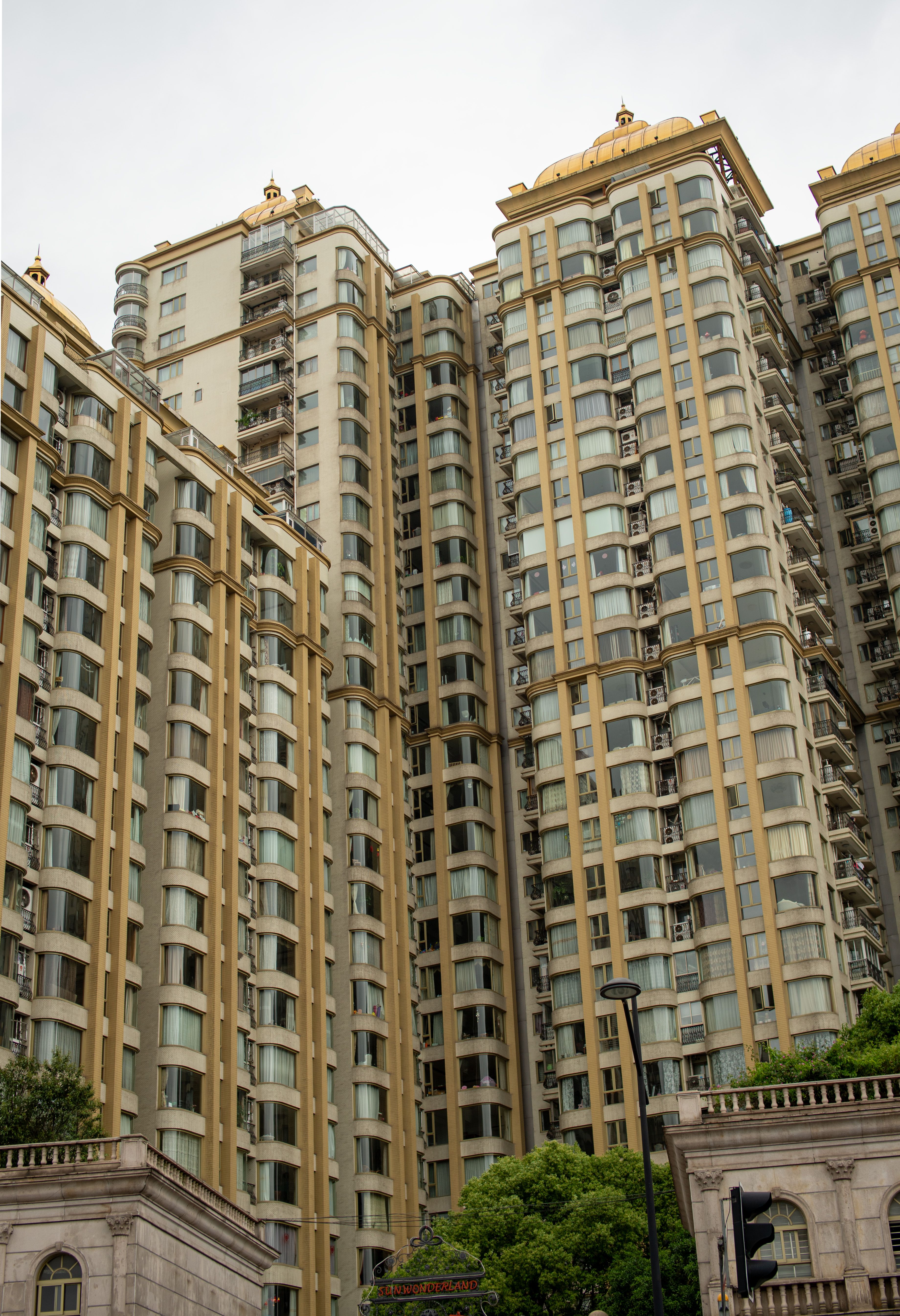
Newer homes (built after 2010, with elevators, over 70 sqm) retain a price floor from their residential qualities even if the school attribute partially fades. Take Xuhui as an example: old, small units zoned to Xiangyang Primary School fell roughly 20–30% between 2021 and 2026, while newer homes in the same area (e.g., Xuhui Riverside / 徐汇滨江 and Tianlin / 田林 precincts) declined only 5–15% over the same period—the two trajectories have clearly diverged.
[UNIQUE INSIGHT] I've noticed a counterintuitive phenomenon: as school district premiums shrink, "newer homes" within quality districts are actually acquiring a new premium logic compared with "old, small units." In the past, parents bought run-down units purely for the school registration—they didn't live there, so the physical quality didn't matter. As school district uncertainty rises, the mindset is shifting to "if the school district isn't worth this price after all, at least the home itself should be comfortable to live in." This shift in mentality is reshaping the price structure of housing within school districts. In the same Xiangyang Primary School zone, a newer apartment in 2026 actually drew more inquiry traffic than in 2022, while inquiry traffic for old, small units in the same compound is still declining.
How Should Young Couples Calculate the Real Return on School District Housing?
Setting aside emotion and anxiety, let's answer purely in numbers: if you buy a school district home, what exactly does your money buy?
The Truth About Rental Yields
Shanghai school district housing delivers a gross rental yield of roughly 1.2–1.5%, below the 1.8–2.2% on non-district newer homes (China Index Academy, 2026). Why? Because school district homes carry a 20–50% price premium, but rent only 10–20% more than non-district homes in the same area—you're paying 30–% more to buy, but only recouping 10–20% more in rent.
Consider a concrete example. A 75-sqm newer home in Xuhui's Tianlin (田林) precinct (non-top-tier district) had a market value of roughly CNY 5.2 million in 2026, with monthly rent around CNY 8,000—an annual gross yield of about 1.85%. A 50-sqm run-down unit zoned to Xiangyang Primary School, by contrast, had a market value of roughly CNY 5.5 million, monthly rent around CNY 6,500, and an annual gross yield of just 1.42%—higher total price, smaller footprint, and a lower yield to boot.
The Math of Premium Amortization
Let's run a more complete set of numbers. Suppose you buy a school district home in 2026 for a total of CNY 6.5 million (including a school district premium of roughly CNY 1.5 million, or 23%), with a 35% down payment (CNY 2.275 million) and a 30-year mortgage. Compare two alternative scenarios:
- Option A: Buy the school district home, hold for 10 years.
- Option B: Buy a non-district newer home in the same area for CNY 5 million, and invest the CNY 1.5 million down-payment savings plus the monthly holding-cost difference in an index fund.
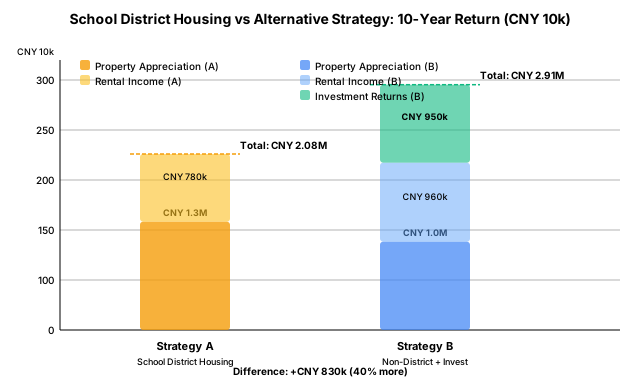
Under moderate assumptions (2% annual price growth, flat rent, 5% annual return on the invested difference), Option B's cumulative net return over 10 years exceeds Option A's by roughly CNY 800,000–1.2 million. That CNY 800,000–1.2 million is the premium you're paying for "school district certainty"—and if that certainty is discounted at any point during the holding period (teacher rotation expands, multi-school zoning expands, the birth rate decline creates a surplus of school places), Option A's actual return will be even lower.
Three Key Variables
The real return on school district housing is highly sensitive to three variables:
- Holding period: The shorter the period, the worse the outcome. The high premium on school district housing needs a long holding period to amortize; holding for fewer than 7 years carries the highest probability of a loss (because transaction taxes further erode returns).
- Policy risk: A single expansion of multi-school zoning can shrink the premium by 5–15 percentage points overnight—and that's unhedgeable.
- Years to enrollment: If your child starts school within 3 years, the "use value" of the school district premium is clearest; if enrollment is 7 years away, policy uncertainty is extremely high, and the rationale for paying a premium is weakest.
What Are the Alternatives to Buying School District Housing?
If you've concluded that "the school district premium isn't worth it," Shanghai young couples still have several alternatives worth considering.
Path 1: Quality Private Schools (Lottery)
Shanghai private schools admit by lottery. In 2025, the average acceptance rate for popular private primary schools was roughly 15–25% (varying widely by district). While the odds aren't high, the cost is far lower than a school district housing premium—annual tuition runs about CNY 50,000–150,000, totaling CNY 300,000–900,000 over 6 years, versus a school district premium that routinely runs CNY 1.5–3 million. Even factoring in the "worst case" of not winning the lottery (and falling back to the zoned public school), the expected cost is still lower than buying a school district home.
Path 2: International School Route
If you're considering studying abroad in the future, Shanghai international schools charge roughly CNY 150,000–250,000 per year, totaling about CNY 1.8–3 million across K–12. This path is completely mutually exclusive with school district housing—once you go the international route, the school district home's value drops to zero. But note that this path is hard to reverse and places high demands on household financial stability and the child's adaptability.
Path 3: Renting + Education Fund Portfolio
This is the optimal solution from a pure financial perspective. Rent a quality home in the same area (CNY 6,000–8,000/month), and invest a portion of the school district premium (CNY 1.5–3 million) in an education fund portfolio (index funds + education annuity insurance). At a 5% annualized return, the education fund would accumulate to roughly CNY 2.45–4.89 million after 10 years—enough to cover private or international school fees, while preserving residential flexibility and portfolio diversification.
Path 4: Talent Immigration / Hukou Channels
Shanghai offers alternative enrollment channels for high-level talent, returning students with overseas degrees, and families who meet the residence permit point threshold. If you or your spouse qualifies under talent immigration criteria (e.g., in-demand specialties at key institutions, senior professional titles, doctoral degrees, etc.), your children's school placement can receive priority arrangement—effectively substituting "personal credentials" for "real estate" to access education resources.
Divergence Trends in Shanghai School District Housing Over the Next Decade
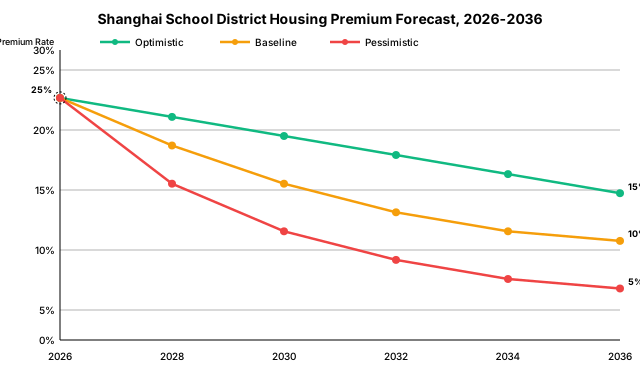
Combining the three forces of policy, population, and education equalization, we construct three scenario projections for Shanghai school district housing from 2026 to 2036.
Scenario Analysis
| Scenario | Assumptions | School District Premium Change | 10-Year Total Return (price + rent) |
|---|---|---|---|
| Optimistic | Policies advance mildly; core district supply-demand remains tight | Premium holds at 15–25% | 2–4% annualized |
| Baseline | Policies advance at the current pace; birth rate stays low | Premium narrows to 10–15% | 0–2% annualized |
| Pessimistic | Policy accelerates (full multi-school zoning coverage); economic downturn compounds | Premium narrows to 5–10% | −2–0% annualized |
Under the baseline scenario, school district premiums will gradually narrow from the current 15–35% to 10–15%. Core districts (Huangpu / Xuhui / Jing'an cores) will outperform the urban fringe, and newer homes will outperform old, small units. Overall, school district housing will shift from "investment asset" back to "consumption good"—you pay for it because you need to use it, not because it will make you money.
Lessons from Beijing
Since Beijing rolled out multi-school zoning in 2020 across hot districts like Desheng (德胜) and Yuetan (月坛), it has provided a ready-made policy experiment. After some neighborhoods in the Desheng district were rezoned out of top-school catchment areas, home prices fell roughly 15–25%, and school district premiums narrowed from a peak of over 50% to 20–30% (Beike Research Institute Beijing Market Report, 2024). Shanghai's policy pace has been more gradual than Beijing's, but the direction is the same—if Shanghai matches Beijing's intensity, the probability of the pessimistic scenario rises sharply.
Decision Framework: Should You Pay the School District Premium?
Synthesizing the analysis above, I've designed a four-quadrant decision framework for Shanghai young couples.
Four Typical Situations
| Situation | Recommendation | Rationale |
|---|---|---|
| Purely school-driven, limited budget | Don't chase old, small units | Premium narrowing + poor liquidity + lending restrictions = unfavorable risk-return |
| Owner-occupier + school district dual need | Choose a newer home in a mid-tier district | Livability is assured, the school district premium is moderate, policy risk is manageable |
| Ample budget, pursuing top-tier education | A top-district newer home is an option | But accept the possibility of premium narrowing; holding period ≥10 years |
| Purely investment-driven | Not recommended | Low rental yield (1.2–1.5%), high policy risk, poor liquidity |
Action Checklist
Before making your final decision, check each item in turn:
- Is your child more than 7 years from enrollment? If so, the policy risk on the school district premium is extremely high.
- Has the target district already been included in multi-school zoning? If so, the certainty has already been discounted.
- Can you accept the "worst case" (being lottery-assigned to a non-target school through multi-school zoning)?
- Has the opportunity cost of the down payment been factored into the calculation? (Return on invested difference vs. return on school district home)
- Is the holding period ≥10 years? If under 10 years, transaction taxes will further erode returns.
- Have you compared the expected cost of the private-school lottery path?
Frequently Asked Questions
Is it more cost-effective to buy Shanghai school district housing or rent in 2026?
From a pure financial standpoint, renting + investing the difference very likely outperforms buying a school district home on a 10-year cumulative return basis (China Index Academy, 2026). But if your child starts school within 3 years and the zoned district's certainty is high, the use value of the school district home can reasonably justify part of the premium. The key variable is years to enrollment—the closer, the more worthwhile; the further, the less worthwhile.
Which Shanghai school districts are most at risk after multi-school zoning?
"Pseudo-districts" carry the highest risk—far-flung new schools marketed on the prestige branch-campus concept (e.g., parts of Lingang / 临港, Huinan / 惠南, and Songjiang New City / 松江新城). Core real districts (Huangpu / Xuhui / Jing'an cores) are supported by community heritage and parent networks, giving them stronger resilience.
Can teacher rotation really make ordinary schools better?
The Shanghai Municipal Education Commission's 2025 evaluation shows that schools integrated into groups for more than three years saw the excellent/good rate of teaching competency assessments rise by an average of 12–18 percentage points. But results vary by school, and parent perception typically lags policy implementation by 2–3 years.
How many years do you need to hold Shanghai school district housing to "break even"?
At the current gross rental yield of 1.2–1.5%, breaking even on rent alone would take 60–80 years—not realistic. The "break even" on school district housing depends on price appreciation, and the appreciation assumption carries extremely high uncertainty during a policy down-cycle. A holding period of ≥10 years is needed to reasonably amortize transaction taxes and the premium cost.
Will Shanghai's "one household per five years" policy be abolished?
The probability of abolition in the short term is low. The policy is an important tool to curb speculation on school district housing and aligns with the current direction of education equalization. Even if adjusted, it's more likely to be a fine-tuning (e.g., relaxing the definition for second/third children) than a full repeal.
Which Shanghai districts have the most resilient school district premiums?
Huangpu District (黄浦区) (historical heritage + scarce supply), Xuhui District (徐汇区) (education powerhouse + the Gao'an Road No. 1 / Jianxiang / Xiangyang cluster), and Jing'an District (静安区) (First Normal School Affiliated Primary / Jing'an Educational Academy Affiliated School + mature communities) show the strongest premium resilience. Inner-ring Pudong (明珠 / 福山) comes next.
If your child doesn't start school for another 7 years, should you buy school district housing now?
Not recommended. Over a 7-year horizon, multi-school zoning could expand, the effects of teacher rotation could become visible, and the enrollment population could decline further—three layers of uncertainty stacked together. The premium you pay today is very unlikely to be fully realized. A more flexible strategy: buy a non-district newer home now to meet your housing needs, then reassess 2–3 years before enrollment based on the policy landscape at that time.
Conclusion
Shanghai school district housing is undergoing a structural shift from a "certainty premium" to a "probability premium." Births halved, teacher rotation fully rolled out, 60% quota allocation to schools, multi-school zoning expanding—under the weight of these four forces, the investment case for school district housing no longer holds.
For Shanghai young couples, the core advice comes down to three points:
- If your child starts school within 3 years—you can pay a reasonable premium for a target district, but prioritize newer homes over old, small units to reduce liquidity risk.
- If your child doesn't start school for another 7 years—don't overpay for a school district. Buy a non-district newer home to meet your housing needs, and adjust once the policy picture is clearer.
- If it's purely an investment—drop the idea. The low rental yield, high policy risk, and poor liquidity of school district housing make it one of the worst asset allocation options available today.
School district housing won't disappear, but it's returning to its essence—a consumption decision about "where your child goes to school," not an investment decision about "how to grow your assets."
Data Sources
- China Index Academy — 100-City Price Index, June 2026
- Shanghai Municipal Bureau of Statistics — Population and birth data, 2024
- Shanghai Municipal Education Commission — Teacher rotation and group-based schooling policies, 2025
- Shanghai Municipal Education Examination Authority — Quota allocation policy, 2025
- Ministry of Education National Education Development Statistical Bulletin — Enrollment data, 2025
- Xinhua — 2024 Shanghai newborn data, 2024
- Beike Research Institute / CRIC — School district premium estimates, 2024–2025
- Yicai (第一财经) — Shanghai population and enrollment analysis, 2025