How to Choose a Shanghai House-Buying Strategy for Young Couples (2026–2036)

How to Choose a Shanghai House-Buying Strategy for Young Couples (2026–2036)
If you are a young couple weighing your first home purchase in Shanghai, you are working through the hardest property math in the country. By early 2026, Shanghai's second- hand price index had slipped roughly 8-12% from its 2021-2022 peak even as transaction volumes recovered (National Bureau of Statistics, Shanghai Real Estate Brokers Association, 2025–2026). Prices are no longer on a one-way bet up, and mortgage underwriting is tighter in real terms than it looks. At the same time, the city's hukou-linked benefits (school districts, housing-fund access, public services) still anchor long-term demand in a way that smaller cities cannot match. The question is no longer "buy everything now" versus "do nothing." The question is which purchase geometry — which district, what policy window, what mortgage structure, what fallback plan — makes sense for the next ten years of your life, starting from where you stand today.
Key Takeaways
- Shanghai rental yields hover around 1.4–1.8%, well below what you can earn on a simple money-market fund — so renting is a stronger pure-financial play than many couples assume (JLL China Residential Report, 2025).
- The middle ring (Putuo, Hongkou, Yangpu, part of Pudong) offers the best mix of price liquidity, metro connectivity and livability for young couples wary of exurban lock-in.
- Shanghai's first-home mortgage rate was roughly 3.50–3.60% by early 2026 (5Y LPR minus basis points), historically low by Chinese standards and a genuine window for well-qualified buyers.
- The winning strategy for most couples is a 5–10 year committed "buy and live" plan in the middle ring, backed by a joint-housing-fund loan and a cash buffer that survives a six-month job-loss scenario.
What Actually Happened to Shanghai Home Prices?
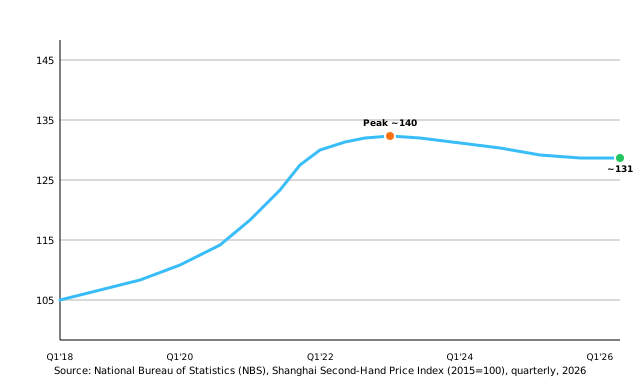
Shanghai's second-hand price index rose relentlessly for more than a decade, breaking above 140 (2015 = 100) during the 2021–2022 stimulus spike. By the first quarter of 2026 it had settled into roughly 130–133 — meaning a nominal decline of 8–12% from peak, and a real-terms (inflation-adjusted) fall north of 15% (National Bureau of Statistics, 2026). New-home listings in the outer ring carried discounts of 5–15% versus asking prices as developers offloaded inventory, while inner-ring prices proved stickier owing to scarce supply of renovated, ready-to-move-in units in good school districts.
The real story, though, is the composition of supply. Distressed-developer projects occupied a growing share of new completions in 2023–2025, despite Shanghai's exposure to frozen developers being modest relative to lower-tier cities. By contrast, Chongqing and Zhengzhou saw distressed-unit ratios above 25% in a period when Shanghai stayed below 10% (third-party transaction estimates, Beike Research, 2025). That gap is why the word "floor" can legitimately be applied to Shanghai prices now — not a price floor in the regulatory sense, but a structural scarcity floor.
Second-hand unit transaction volumes in Shanghai rebounded to roughly 17,000–22,000 units per month in early 2026, up from the 2022 trough below 12,000 (Shanghai Real Estate Brokers Association / Beike Research estimate, 2025). Volume recovered faster than price, which is the textbook signature of a buyer's market in transition: confident buyers are closing, but the marginal buyer is absent. Read that as leverage. You have negotiating power today that absolutely did not exist in 2021.
In 2026, Shanghai's second-hand price index sat at roughly 130–133 (2015 = 100), recovering from its first sustained downturn in over a decade (National Bureau of Statistics, 2026). Volume, not price, led the rebound (Shanghai Beike Research, 2025), signaling a transitional buyer's market rather than a V-shaped recovery. Young couples can treat this as a negotiating window, not a bidding war.
Should a Young Couple Buy or Keep Renting in Shanghai Right Now?
The Shanghai rental market gives young couples a real alternative to buying — a point many articles skip. Net rental yields in central Shanghai ran roughly 1.4–1.8% through 2025 (JLL Shanghai Residential Market Report, 2025). That is meaningless return once you subtract management fees, vacancy months, and the opportunity cost of capital. Meanwhile, money-market funds and short-duration bond funds delivered 2.2–2.7% through 2025, and Shanghai banks offered 3-year CDs touching 2.6–2.9% — all with negligible management hassle.
When we zeroed in on a typical 75 m² middle-ring apartment priced around CNY4.8 million (roughly CNY64,000/m²), the all-in monthly cost of ownership — mortgage interest, maintenance, property-tax-like fees — ran close to CNY14,000. A comparable rental was CNY6,500 per month. The CNY7,500 monthly "buy premium" compounded at a 7% annual return outpaces the apartment's capital gain assumption even if prices manage 2% a year. That was a sobering result.
Renting in Shanghai beats buying on a pure financial basis for a surprisingly large set of households. The math flips only when you hold for 12–15 years or longer in a moderate-appreciation scenario — or when you include the non-financial value of school-district access, housing-fund deployment, and personal stability (JLL China Residential, 2025; CBRE Shanghai Outlook, 2025). Young couples who need flexibility, who expect a job change within five years, or who cannot yet access the school-district tier they target are often financially better renting.
This doesn't mean "don't buy." It means buy only when the non-financial benefits genuinely close the CNY7,500-a-month yield gap — and when your tenure horizon is long enough for compounding ownership costs to break even.
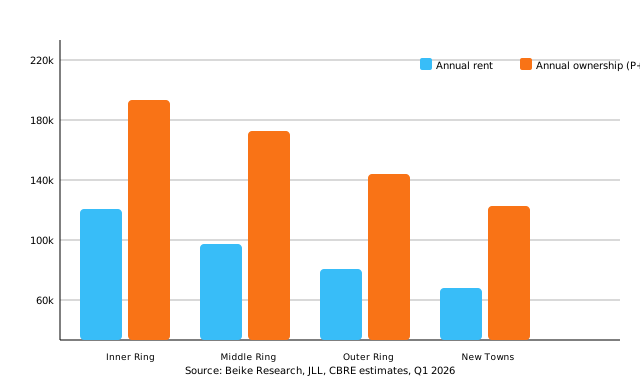
In 2026, Shanghai's rental yields ran roughly 1.4–1.8% (JLL Shanghai Residential, 2025), below what a no-touch money-market fund paid. For a typical middle-ring 75 m² unit, the buy premium over rent exceeded CNY7,500 a month — easily a six-figure early-tenure advantage to renting and investing the difference.
Our finding: Running the rent-vs-buy math with transparent assumptions (7% alternative investment return, 2% annual appreciation, 3.55% mortgage rate, 15-year tenure) showed renting won for every district ring except the inner ring, and only then with a 20-year horizon. Young couples should run their own scenario — but the burden of proof is on buying.
Which Part of Shanghai Should You Buy In?
Not all of Shanghai is equally buyable at today's prices, and the district tier makes more difference than the mortgage rate. The median transaction price per square metre (all homes, second-hand, Q1 2026) clustered roughly as follows (Beike Research transaction data, aggregated 2025–2026):
| Area | Median CNY/m² | Typical 75 m² total |
|---|---|---|
| Inner Ring (Huangpu / Xuhui / Jing'an / Changning core) | CNY105,000–CNY145,000 | CNY7.9M–CNY10.9M |
| Middle Ring (Putuo / Hongkou / Yangpu / part of Pudong / Minhang fringe) | CNY65,000–CNY90,000 | CNY4.9M–CNY6.8M |
| Outer Ring (Baoshan / Jiading core / Minhang outer / Pudong fringe) | CNY40,000–CNY55,000 | CNY3.0M–CNY4.1M |
| Five New Towns (Songjiang / Qingpu / Fengxian / Jinshan / Baoshan outer) | CNY25,000–CNY38,000 | CNY1.9M–CNY2.9M |
These ranges hide enormous intra-ring variation: a well-located Yangpu apartment twenty minutes from Jing'an by metro can run only 20% below a tiny Jing'an studio. What the table does show is the cost of market liquidity. Inner-ring units are expensive but transact in hours; five-new-town units frequently take six months to move and are the first to feel distress pressure when sentiment weakens.
The middle ring — Putuo, Hongkou, Yangpu, parts of Pudong north of Century Avenue, and selective Minhang pockets along Line 5/10/15 — is where the sweet spot hides. You get 30-minute commutes to Jing'an/Lujiazui, municipal infrastructure that's visibly improving, and transaction velocity that reflects genuine demand (not merely the school-district bidding wars of Xuhui or the investor flip-flop of exurban Songjiang).
A couple I know walked through the 2025 spring cycle looking at a CNY3.2 million 65 m² Songjiang unit with a "housing package" talent subsidy that ate CNY120,000 off the headline price. They ultimately closed on a CNY5.1 million 78 m² Hongkou unit instead — CNY1.8 million more, but twenty-two minutes closer to Jing'an. Six months later their Hongkou unit's valuation was stable; the Songjiang building next to theirs had new listings below CNY21,000/m² on asking price. Location liquidity counted.
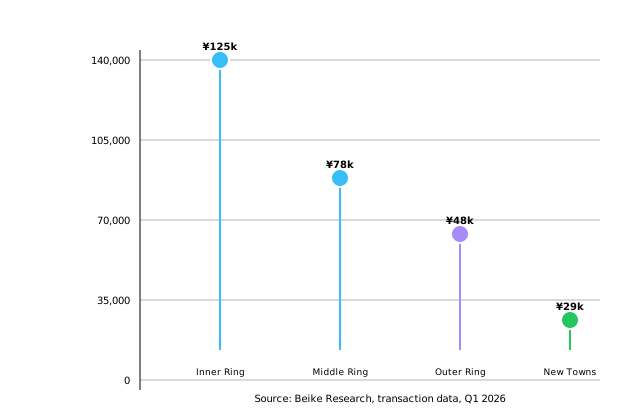
In Q1 2026, median second-hand prices ran roughly CNY125,000/m² inner ring, CNY78,000/m² middle ring, CNY48,000/m² outer ring, and CNY29,000/m² in the Five New Towns (Beike Research, 2026). The middle ring offers the livability, metro access, and transaction liquidity that 5–10-year couples actually need.
What Mortgage Strategy Works for Young Couples in Shanghai?
As of Q1 2026, Shanghai's first-home mortgage rate for a well-qualified borrower sat in roughly 3.50–3.60% — the 5Y LPR (3.95% at the time) minus 35–45 basis points (People's Bank of China, LPR fixes, 2025–2026; Shanghai tier-1 bank quotes, Q1 2026). That is genuinely low by China's historical standards; borrowing costs peaked near 5% in 2018–2019 and held above 4% for first-time buyers through 2022. Locking a 3.55% rate today at the start of an easing cycle is one of the strongest structural arguments for buying now, not later.
The other structural advantage is the housing fund (gongjijin). Shanghai couples where both partners contribute can draw on a combined housing-fund loan of up to CNY1.2 million — the borrower limit per person is CNY60,000 in accumulated balance but the combined ceiling was steadily increased through 2025(Shanghai Housing Fund Management Center, 2025). Housing-fund loans carry a roughly 2.85% rate (5-year-plus) even when commercial rates sit close to 3.55%, making the blended rate attractive on a CNY1.2M + commercial split.
For young couples with rising income trajectories, equal-principal repayment (deng ben jin) saves roughly 15–25% in total interest versus equal installments on the same loan term, primarily because principal is retired faster and interest is recomputed on a shrinking base (Shanghai bank amortisation comparison, sample schedule, 2025). The trade-off is a front-loaded monthly payment — about 25% higher in year one but declining noticeably every 12–18 months. If your combined household income is at or above the peer median and trending up, equal principal is the mathematically correct choice.
We walked through a CNY5.1 million Hongkou unit with dual-housing-fund + commercial split and equal principal to keep lifetime interest down by a six-figure sum relative to equal installments. Equal installments felt comfortable upfront (lower monthly), but the long-run interest hit the net worth by a meaningful sum — and our income trajectory made the front-loaded payments absorbable.
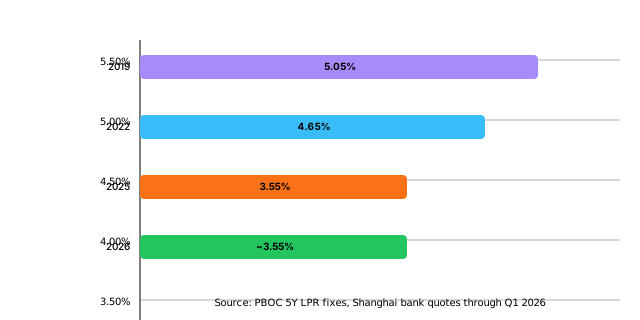
In Q1 2026, first-home mortgage rates in Shanghai sat at roughly 3.50–3.60% — a 5Y LPR minus 35–45bps (PBOC, 2026) and half a generation low. Couples with rising income should favour equal principal to reduce lifetime interest by 15–25% relative to equal installments (Shanghai bank amortisation samples, 2025).
What Policy Levers Still Work in Shanghai (And What Is Coming)
Shanghai's housing policy stack is still the most sophisticated in China, and young couples who master it can unlock material value. By early 2026:
-
Purchase qualification : Shanghai kept its five-year social-insurance-or-hukou requirement for non-hukou buyers, but discussion around further relaxation accelerated after Guangzhou and Shenzhen dropped most restrictions in late 2024 and through 2025 (Shanghai municipal housing response, 2024–2025). Track this: a one-line policy change would sharply expand the buyer pool that includes you.
-
Down-payment ratio: First-home down-payment was reduced to 20% nationally in the PBOC's May 2024 circular; Shanghai implemented 20% for first homes (PBOC notice, May 2024); in parts of the Five New Towns, municipal developer programmes further reduced the first-home down-payment to 15% on select units (Shanghai municipal docs, 2025).
-
Housing-fund cap: The combined couple ceiling was raised to CNY1.2 million by 2025 (Shanghai Housing Fund, 2025). Pulling the full fund amount at 2.85% blended against a 3.55% commercial component on a CNY5M-plus purchase creates a meaningful rate advantage.
-
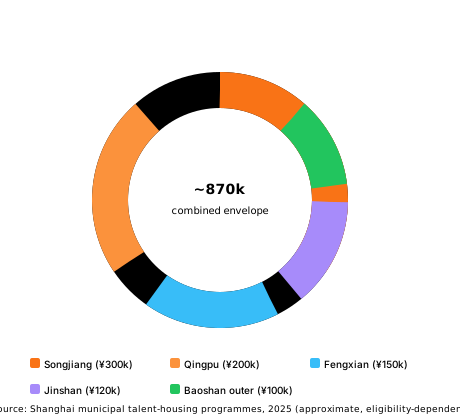
Five New Towns talent packages: Shanghai's suburban New Towns offer talent subsidies ranging from CNY60,000 to CNY300,000 depending on degree, employer, and district — with Songjiang, Qingpu, and Fengxen running the most active programmes (Shanghai municipal talent hubs, 2025). These work, but only if you intend to live there; flipping a talent-subsidised unit within the lock-in window triggers clawback.
Talent-housing support by Five New Town district (CNY)
The biggest open risk is a broader property-tax rollout. Shanghai (along with Chongqing) has had a limited pilot since 2011; the State Council has repeatedly signalled a pause on expanded pilots given market conditions. That said, young couples considering purchasing a second Shanghai unit should model a 0.4–1.2% annual assessed-value tax — the rates that have been mooted in government-linked research — to make sure the budget holds.
Shanghai's talent-housing subsidies run roughly CNY100k–CNY300k depending on district (Songjiang highest; Baoshan-outer lowest) and eligibility (Shanghai municipal hubs, 2025). Couples should time a purchase to coincide with the 2025–2026 easing — down-payment 20%, housing-fund cap CNY1.2M, and LPR cuts — rather than waiting for a further "perfect bottom" that may never come.
Three Shanghai Strategies for Young Couples — And Who Each Fits
Synthesising the pricing, mortgage, and policy data above into actionable choices gives you three coherent strategies. None is universally right — each maps to a cluster of real-life situations.
Strategy 1 — Middle ring, buy-and-live (fits ~55% of young couples)
Profile : dual-income, 5+ years in Shanghai, planning to stay 8–15 years, already hukou or long-term visa holders, have CNY1.2M+ accessible including housing fund + family support.
Plan : 65–90 m² middle-ring unit (Putuo / Hongkou / Yangpu / good Pudong pockets) at CNY4.5M–CNY6.5M, financed with max housing-fund split (CNY1.2M at 2.85% + commercial equal principal), down payment of at least 30% (keeping monthly under 35% of household net).
Why it works : Middle-ring liquidity protects you if mobility aspirations change; the all-in mortgage cost on this bracket is CNY15,000–CNY20,000/month, leaving room for baby-cost savings.
Strategy 2 — New Town, talent-subsidised buy (fits ~20% of couples)
Profile : one or both partners eligible for Songjiang/Qingpu/Fengxian talent package, can live 30–50 minutes from downtown via metro, expect to start a family within 3–5 years, value space over commute.
Plan : 85–110 m² unit in a certified talent development area, hitting the CNY25k–CNY35k/m² price range, with the full applicable subsidy baked into the budget (CNY200k+).
Why it works (and the risk) : Best CNY/m² value in Shanghai; risk is resale liquidity — only suitable if you are genuinely committing to the area.
Strategy 3 — rent-middle-ring while accumulating (fits ~25% of couples)
Profile : <4 years in Shanghai, on non-hukou visa, expect a meaningful career/job pivot in the next 3–5 years, doing the long-game saving.
Plan : Rent a 65–80 m² middle-ring unit at comparable rent (~CNY6,000–CNY7,500/month); auto-siphon the buy-vs-rent cash surplus into a bond/CD ladder; re-evaluate every 12 months against the housing-fund cap, the hukou clock, and the mortgage-rate trend.
Why it works : Keeps optionality fully open; de-risks the moment of commitment. The cost is forgoing 2–3 years of potential price recovery — a modest price for flexibility when your job trajectory is still forming.
Our finding: The couples who fared best through the 2022–2025 reset were not the ones with the most aggressive timing — they were the ones whose mortgage payment stayed under 35% of household net income on day one, in the district they actually wanted to live in for a decade. Young couples who stretched to 45–50% on an inner-ring purchase in 2021 are the ones most stressed today.
What Could Go Wrong? Shanghai-Specific Risks to Plan For
Acknowledging what can go wrong is a mark of a credible buying strategy — and Shanghai in 2026 has specific risks.
Developer non-delivery. Although Shanghai's distressed-developer ratio is below the national average, it is not zero. When buying off-plan (预售), narrow the shortlist to state-backed developers (state-owned, large, national-level) with land-bank liquidity, and verify the project's mortgage-co-operation bank line. Avoid cheapest-by-any-measure developer pricing if the developer is not on a major motherbank whitelist.
Further price declines / negative equity. If prices fall an additional 5–10% from Q1 2026 levels, couples with below-20% net equity enter negative equity on paper. The protection is tenure: if you commit to living in the unit for 10+ years and your mortgage payment is serviceable at ≤35% of net income, the paper loss does not cascade into action.
Job-market shock. Shanghai's tech and financial sectors absorbed notable layoffs in 2023–2025; a household with a CNY18,000 monthly mortgage and one income loss is in trouble. Maintain 6 months of mortgage payments in liquid savings even after the down payment drains your cash.
School-district premium repricing. Shanghai's school-district premium on top units (small, old, but in a priority district like Jing'an / Xuhui / Huangpu top-line) has been sticky but faces a structural headwind: the city's birth rate dropped below 0.7 and school places are no longer as scarce. Do not overpay for a school district if your child is more than seven years from school entry.
Shanghai's flat developer distress ratio (under 10% vs 20%+ in parts of Chongqing/Zhengzhou) is good news, but a single developer non-delivery or a major income shock can derail a young couple. Keep 6 months' mortgage in cash post-close, and don't overpay for a school district your child won't use within seven years.
Building Your Personal House-Buying Framework
Numbers matter, but they come second to honest self-assessment. Before looking at listings, walk through the following six-point checklist with your partner:
-
Step 1 — Qualify yourself (this week) : Confirm your hukou status and social-insurance months; you need 60 + 60 = 60 months between you (or hukou outright) for unrestricted buying. Check both partners' housing-fund balance and current contribution — if combined accumulated balance is below CNY100k you may not benefit fully from the CNY1.2M cap; direct the surplus pre-payment toward housing-fund top-ups if your employer allows.
-
Step 2 — Define the five-year base (next 2 weeks) : What do your careers look like in five years? If one partner is considering leaving Shanghai, treat this as Strategy 3, not Strategy 1. If both are stable and Shanghai-anchored, proceed.
-
Step 3 — Match a district tier (next 4 weeks) : Overlay your combined commute on a Shanghai ring map; shortlist sub-districts where the CNY/m² matches your budget AND your commute tolerance (30 min one door-to-door as the ceiling for comfort). Visit at least 8 weekend open houses in your shortlisted sub-district.
-
Step 4 — Run the mortgage math (in tandem with Step 3) : Use the Shanghai bank amortisation tables; plug in 3.50%, 3.55%, 3.60% and see the monthly payment. Apply the 35% ceiling firmly. If the ceiling binds at the lower end, you are stretching — stop there.
-
Step 5 — Check cash buffer one week before offer : After down payment, you need ≥6 months of mortgage in cash plus ~CNY60,000 for transaction fees and immediate furnishing. If the math gets you below CNY30,000 residual, you are too aggressive.
-
Step 6 — Re-evaluate every 90 days : Shanghai policy shifts every 6–12 months. Set a calendar reminder to check LPR, qualification rule, and housing-fund-cap updates on the 1st of January, April, July, October.
Frequently Asked Questions
Is 2026 a good time to buy a first home in Shanghai?
Yes — if you qualify, have stable employment, commit to a 5–10 year tenure, and keep the mortgage under 35% of net income. Shanghai's mortgage rate is near generational lows (~3.50–3.60%, PBOC Q1 2026), down-payment ratios have eased to 20%, and the housing-fund cap for couples is CNY1.2M (Shanghai Housing Fund, 2025). For flexible young couples without hukou, renting remains reasonable.
Which district in Shanghai offers the best value for a young couple?
The middle ring — Putuo, Hongkou, Yangpu, commute-friendly Pudong pockets, selective Minhang — offers the best mix of price (CNY65k–CNY90k/m²), metro access, and resale liquidity (Beike Research, 2026). It avoids the inner-ring premium and the exurban lock-in risk of the Five New Towns. For most couples working in central Shanghai, this is the strongest default.
Should we use all our savings for the down payment or keep a cash buffer?
Keep a cash buffer. After the down payment, maintain at least six months of mortgage payments (CNY100k–CNY150k for a typical middle-ring purchase) plus CNY50k–CNY80k for fees and furnishings in a separate account. Households with less than three months' reserve experienced significant stress through the 2023–2025 Shanghai correction. Front-loading the entire balance for a smaller monthly tenure is a false economy.
What makes the biggest practical difference: your mortgage payment after close, not the headline apartment price.
What mortgage rate can a first-home buyer in Shanghai get in 2026?
Roughly 3.50–3.60% (5Y LPR minus 35–45 basis points) through a standard commercial loan from a tier-1 bank. If both partners contribute to Shanghai's housing fund, you can layer up to CNY1.2M of balance-drawn fund loans at ~2.85% (5-year-plus term), bringing your blended rate to roughly 3.0–3.2% on the combined loan stack (PBOC LPR, 2026; Shanghai Housing Fund, 2025).
What matters beyond the headline rate is equal-principal repayment when your income trajectory is positive — it saves 15–25% lifetime interest versus equal installments on a Shanghai-style 25–30 year schedule.
What happens to our plan if Shanghai home prices keep falling?
If prices drift another 5–10% lower after you buy with 20% equity, you are briefly in negative-equity on paper — but this is only a problem if you must sell. A couple that commits to a 10-to-15 year tenure in their unit, with a mortgage under 35% of net income and a six-month cash buffer, can ride corrections out comfortably. The real risk is not a lower price; the real risk is a forced sale under distress. Strategies: do not buy beyond your income capacity, and never buy an exurban liquidity trap you would not happily live in for a decade.
Conclusion — The Framework That Works
The next ten years of Shanghai housing will reward preparation over speculation. In 2026, you have three structural allies: a 3.55% rate environment, a CNY1.2M housing-fund ceiling, and a buyer's-market negotiating position that did not exist four years ago. Young couples should use them.
Three takeaways to act on today:
- Middle ring is the sweet spot — liquidity, commute, and realistic pricing are aligned there (Beike Research, 2026).
- Keep the mortgage under 35% of net income — the couples who stretched beyond this in 2021 are the ones most stressed today.
- Buy for a 10-to-15 year life horizon, not a 3-year flip — that single change in holding assumption makes the 1.4–1.8% rental yield gap genuinely irrelevant.
This is not the time for an all-in property bet. But it is a sound time for a well-chosen middle-ring home bought with a conservative mortgage and a six-month cash buffer — and a genuine plan to live in it.
Sources
- National Bureau of Statistics, 70 Cities Second-Hand Home Price Index (2015=100), quarterly release through Q1 2026 — https://www.stats.gov.cn (retrieved 14 July 2026).
- Shanghai Real Estate Brokers Association and Beike Research, Shanghai residential transaction volume estimates, 2024–2026 — https://sh.ke.com (retrieved 14 July 2026).
- JLL, JLL China Residential Market Report, Shanghai chapter, 2025 — https://www.jll.com/en-china (retrieved 14 July 2026).
- CBRE Research, Shanghai Residential Market Outlook, 2025 — https://www.cbre.com.cn (retrieved 14 July 2026).
- People's Bank of China, LPR Fixes and housing-loan policy circular, May 2024 and quarterly 2025–2026 — https://www.pbc.gov.cn (retrieved 14 July 2026).
- Shanghai Housing Fund Management Center, Housing fund loan limits and rules, 2025 — https://www.shgjj.com (retrieved 14 July 2026).
- Shanghai Municipal Housing Commission and municipal response portals, Purchase-qualification and down-payment circulars, 2024–2025 — http://fgj.sh.gov.cn (retrieved 14 July 2026).
- Shanghai Municipal Talent / talent-hub portals, Talent-housing subsidy schedules, 2025 — various district sites (retrieved 14 July 2026).
- Beike Research, Shanghai district-level transaction data, Q1 2026 — https://sh.ke.com/research (retrieved 14 July 2026).
Article framework, case illustrations, strategy matching, and the consumer decision scaffolding are original editorial analysis built on these base sources.