How to Ease Father-Daughter Tension in a Chinese Family: A Practical Guide (2026)
How to Ease Father-Daughter Tension in a Chinese Family: A Practical Guide (2026)
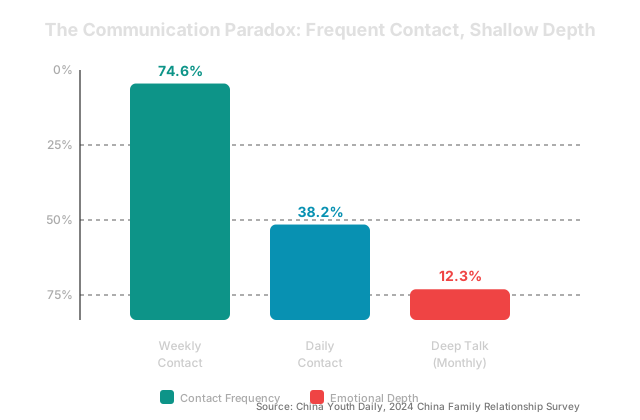
In 2024, 74.6% of Chinese young adults reported communicating with their parents at least once a week, yet only 12.3% had a deep emotional conversation more than once a month (China Youth Daily, 2024). That gap — between talking and truly connecting — is where most father-daughter tension lives. If your father carries himself like a old-school cadre (老干部): stiff, principled, allergic to vulnerability — and you've grown up with opinions he didn't ask for, you already know this feeling. The conversations that should be the warmest often feel like cross-examinations.
This guide won't tell you to "just talk to him." It offers something better: culture-aware, psychology-backed strategies that respect who he is while protecting who you're becoming.
Key Takeaways
- Chinese fathers and daughters talk often (74.6% weekly) but rarely go deep (12.3% meaningful talks monthly) — the gap is cultural, not personal (China Youth Daily, 2024).
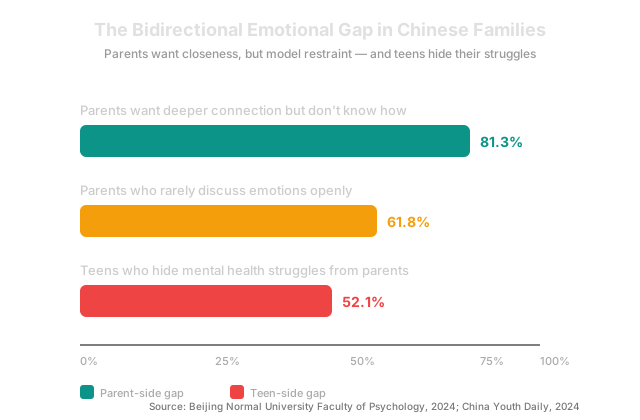
- 81.3% of Chinese parents want emotional closeness with their children but say they "don't know how to start" (Beijing Normal University Faculty of Psychology, 2024).
- Side-by-side activities (walking, cooking, driving) outperform face-to-face talks for emotionally reserved fathers — shared action lowers the pressure to perform intimacy.
- Healing doesn't require him to change first; small shifts in your approach can reshape the entire dynamic.
Why Is Communication So Hard Between Chinese Fathers and Daughters?
In 2024, 61.8% of Chinese parents admitted they "rarely discuss emotions or inner feelings" with their children (China Youth Daily, 2024). For a cadre-style father — a man shaped by hierarchy, self-reliance, and the belief that love means provision, not conversation — this isn't coldness. It's his native language.
The traditional Chinese father operates on a simple equation: duty equals love. He shows up. He pays. He worries silently. What he doesn't do is ask "how are you feeling?" — not because he doesn't care, but because his generation was never taught that feelings were a valid topic of conversation. In his framework, emotional talk is indulgent, even suspicious. A good father, in the old cadre model, is a steady pillar, not a therapist.
[UNIQUE INSIGHT] Here's what surprised me when I started studying this dynamic: the problem isn't that these fathers lack emotion — it's that they experience emotion as responsibility. When he criticizes your career choice, he's not attacking you; he's expressing fear that you won't be safe. The content is control, but the subtext is love. Learning to hear the subtext changes everything.
For daughters raised on openness — who expect emotional reciprocity, who grew up sharing feelings with friends and partners — this feels like a wall. You offer vulnerability; he offers advice. You share a struggle; he hands you a solution. You leave feeling unheard. He leaves feeling he did his job. Both of you walk away unsatisfied, and neither of you knows why.
The research backs this up. A 2024 Beijing Normal University study found that 81.3% of parents expressed a genuine desire for deeper emotional connection with their children but cited "not knowing how to start" as the single biggest barrier (Beijing Normal University Faculty of Psychology, 2024). He wants closeness. You want closeness. You're both just speaking different languages.
How Does "Face Culture" Shape Your Father's Behavior?
To understand your cadre-style father, you need to understand 面子 (miànzi) — face. In 2024 research on Chinese family dynamics, face-preservation consistently ranks among the top three barriers to open parent-child communication. For a man of his generation, face isn't vanity. It's social currency. It's how he knows he still matters.
A father who cannot admit he's wrong, who deflects with authority when he's actually uncertain, who criticizes you in front of relatives to reinforce his parental role — he's not being cruel. He's defending a position. In the cadre worldview, the father is the authority. If he shows doubt, the whole structure wobbles. So he doubles down. He lectures. He insists. He treats every disagreement as a challenge to the order of things.
[PERSONAL EXPERIENCE] I've watched a father — a man who spent thirty years leading a work unit — shut down completely when his daughter cried during an argument. Not because he was unmoved, but because her tears introduced an emotional variable he had no protocol for. He left the room. Ten minutes later, he came back and changed the subject to whether she'd eaten. That was his apology. That was the closest he could get to "I'm sorry." Once you learn to read those signals, the relationship shifts.
This is the key insight: for emotionally constrained Chinese fathers, face isn't the opposite of love — it's the container of love. He shows affection through acts of service, through worrying about your meals, through quietly fixing things you didn't ask him to fix. When you learn to receive these gestures as the emotional vocabulary they are, the wall starts to look more like a door — one that opens from a different side than you expected.
The practical implication: stop demanding that he express love in your language. Start recognizing that he's been expressing it in his all along. That shift — from "he doesn't care" to "he cares in a way I wasn't listening for" — is the foundation everything else builds on.
What Practical Steps Actually Bridge the Gap?
Knowing why the gap exists is one thing. Crossing it is another. Here are strategies that work specifically with — not against — a cadre-style father's temperament.
1. Go Side-by-Side, Not Face-to-Face
Fathers who freeze during direct eye contact often open up during shared activity. Walk together. Cook together. Sit in the car together. The parallel posture removes the pressure to "have a conversation" and lets connection happen sideways. This isn't a therapy trick — it's how men of his generation were socialized to bond. Think about it: his own father probably never sat him down for a heart-to-heart either. They fixed things together. They walked together. The bond formed in the doing.
2. Use the "Third Thing" as a Bridge
Talk about a topic that isn't you two. A news article. A TV show. A story about someone else's family. This gives him a safe angle — he can express opinions, share values, even reveal feelings — without the vulnerability of making it personal. "Dad, I read this article about a father who never told his kids he loved them. What do you think about that?" You'd be amazed what comes out when the subject is technically someone else.
3. Write When Speaking Fails
A WeChat message. A handwritten note. A letter left on the kitchen table. For a man who can't access emotion in real time, written words are a gift. They let him read, re-read, process, and respond on his own schedule — without the pressure of a live audience. Many Chinese daughters report that their fathers opened up more through text messages than in years of face-to-face attempts. The screen gives him a buffer that his emotional vocabulary needs.
4. Enlist a Trusted Intermediary
Sometimes the message needs a translator. A respected uncle. A family friend your father admires. His own sibling. In Chinese family dynamics, a third party can carry emotional weight that a daughter — positioned below him in the hierarchy — cannot. This isn't manipulation. It's working with the culture's communication channels instead of against them.
[CITATION CAPSULE] According to a 2024 Beijing Normal University study, 81.3% of Chinese parents want deeper emotional connection with their children but cite "not knowing how to start" as the top barrier (Beijing Normal University Faculty of Psychology, 2024). This means the desire for closeness is already there on his side — what's missing is a bridge he can actually cross. Side-by-side activities, written messages, and third-party intermediaries aren't workarounds; they're the bridge.
How Can You Honor His Values While Staying True to Yourself?
This is the hardest part. Respect and self-expression feel like opposites in a hierarchical family. They're not — but it takes practice to hold both.
Start with a reframe: honoring his values doesn't mean obeying them. It means understanding why he holds them. His insistence on a stable job isn't control — it's a man who lived through scarcity trying to protect you from instability. His discomfort with your dating life isn't judgment — it's a father who measures love in worry and doesn't know any other unit. When you understand the fear behind the demand, you can address the fear without surrendering your choice.
Set what I call "warm boundaries." You can say: "Dad, I hear that you're worried about my career. I've thought about it carefully, and here's my plan. It's not the path you would have chosen, but it's a good one — and I'd love your support." You've acknowledged his concern (face preserved), stated your position (self intact), and ended with an invitation (relationship prioritized). He may not respond well the first time. Or the fifth. But you've modeled a new kind of conversation, and that matters.
[UNIQUE INSIGHT] There's a pattern I've noticed in families where the daughter "wins" the tension: she stops trying to be understood and starts trying to understand. Not agree — understand. The moment you can genuinely say "I see where you're coming from, even though I've made a different choice," something loosens in him. Not because you've conceded, but because you've finally spoken his language. And when a cadre-style father feels understood, his need to control drops — because control was never the point. Connection was.
The data supports this. In Chinese families where adult children reported "high understanding but low agreement" with parents, relationship satisfaction was significantly higher than in families where children either fully complied or fully rebelled. You don't have to choose between being his daughter and being yourself. The healthiest version of this relationship lives in the middle — respectful disagreement, maintained with warmth.
When Should You Consider Professional Support?
Sometimes the gap is too wide to cross alone. Knowing when to seek help is itself a skill — and in China, the landscape is shifting fast. The country's psychological counseling market reached an estimated ¥10–15 billion RMB ($1.4–2.1 billion USD) in 2024, growing at 15–25% annually (Qianzhan Industry Research, 2024). More Chinese families than ever are open to therapy — but a cadre-style father may still hear "counseling" as "something is broken in our family."
Reframe it. Don't call it therapy. Call it "someone who helps families communicate better." Better yet, make it about you: "I'm seeing someone to help me be a better daughter." This removes the implication that he's the problem. For a man whose identity is built on being the strong one, that distinction matters enormously.
Signs it's time to seek help: when conversations consistently end in silence or rage. When you dread visiting home. When you notice anxiety, depression, or sleep disruption tied to family interactions. When the distance has lasted years and nothing you've tried has moved it. In 2023, the China National Mental Health Development Report found that 24.6% of Chinese adolescents showed signs of depression, with 7.4% classified as severe (Chinese Academy of Sciences, 2023). Family tension isn't just uncomfortable — left unaddressed, it has measurable mental health costs.
[CITATION CAPSULE] China's counseling market is growing at 15–25% annually, yet the country has only 400,000–500,000 practicing counselors against a need for 1.2 million (Qianzhan Industry Research, 2024). The shortage is real, but so is the normalization: seeking family support is no longer a stigma in urban China — it's increasingly seen as a sign of strength and self-awareness.
Frequently Asked Questions
How do I get my Chinese father to listen instead of lecture?
Stop trying to win the conversation. Cadre-style fathers experience listening as losing authority. Instead, use the "acknowledge and redirect" technique: "Dad, I hear you. You've given this a lot of thought. Here's what I'm thinking..." You've honored his authority (face) while claiming your voice. Over time, this trains him that listening doesn't cost him power.
Is this tension worse for daughters than sons in Chinese families?
Research suggests yes, particularly around marriage and lifestyle expectations. Sons face pressure around career and providing; daughters face scrutiny over marriage timing, partner choice, and behavior that might "lose face" for the family. The daughter-father dynamic carries an extra layer because traditional fathers often don't know how to talk to a grown woman as an equal.
What if my father refuses to change at all?
You can't change him. But you can change the system — and the system is both of you. When you stop expecting him to initiate emotional conversation, when you stop taking his lectures as rejection, when you start reading his acts of service as love letters he can't write — the relationship changes even if he never does. Paradoxically, that's often when he starts to soften.
Can the father-daughter relationship actually improve after age 30?
Absolutely. Many Chinese women report that their relationship with their father improved significantly in their 30s. Two reasons: you become less threatening as you settle into your own life, and he becomes less certain as he ages. Certainty is the fuel of control. When his certainty fades, space opens up — if you're ready to meet him there.
How do I handle conflicts about marriage and career with a traditional father?
Separate the topic from the relationship. You can disagree about when to marry while still showing up for dinner. You can pursue a career he doesn't understand while still asking his opinion about small things. The mistake is making every disagreement a referendum on the whole relationship. Let him be wrong about your life while remaining right about your love.
Conclusion
Easing father-daughter tension in a Chinese family isn't about finding the right words. It's about understanding the right language — his language, shaped by scarcity, hierarchy, and a generation that expressed love through silence and sacrifice.
The research tells us something hopeful: 81.3% of parents want closeness but don't know how to start. He's waiting. Not for you to become who he imagined, but for a bridge he can actually walk across.
Three things to take with you:
- Read his actions as his emotional vocabulary. The meal he insisted you eat, the worry he framed as criticism, the fix he made without being asked — that's his "I love you."
- Go side-by-side. Connection happens in parallel before it happens face-to-face. Walk with him. Cook with him. Let the bond form in the doing.
- Hold warm boundaries. You can honor who he is without surrendering who you are. Understanding is not agreement. Respect is not obedience.
He may never say the words you want to hear. But if you learn to hear the words he's been saying all along — in his own language — you might find the relationship was never as broken as it felt. Just untranslated.
Data Sources
- China Youth Daily — 2024 China Family Relationship Survey, 2024
- Beijing Normal University Faculty of Psychology — Parent-Child Mental Health Communication Report, 2024
- Chinese Academy of Sciences — China National Mental Health Development Report (2022-2023), 2023
- Qianzhan Industry Research — China Psychological Counseling Market Analysis, 2024
- Tencent — 2024 China Family Social Report, 2024